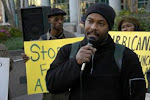
The housing bust and faulty government policies have immersed the United States in a full blown economic and housing crisis. The cruel irony of this crisis, and what makes it so profoundly immoral, is that the commodity at its root- housing- is not at all in scarcity. To the contrary, sufficient vacant housing stocks exist to accommodate virtually everyone in need, including families forced into overcrowded and substandard conditions as well as the homeless.
In the face of this severe economic crisis, people are rising up. They rail against the bailouts and bonuses, protest the lack of lending, rebel against unfair credit card rate hikes and, most dramatically, fight back against losing their homes.
The Take Back the Land Movement is calling for a May 2010 National Month of Action to assert the fundamental human right to housing and community control over land. Participating organizations, communities and families are asserting this right in two ways: by “liberating” government, foreclosed and warehoused homes, making them available for families with nowhere else to live, and by protecting families, our neighbors, from foreclosure related evictions from houses, apartments and condos as well as income related evictions from public housing.
Every family, indeed every human being, needs and deserves decent and adequate housing that they can afford, regardless of their income. However, instead of facilitating this need, federal, state and municipal governments are instituting policies and enacting legislation protecting the profits of corporations at the expense and exclusion of families. These policies serve only to compound, rather than end, the crisis. For example, the same financial institutions which caused the crisis, are both bailed out for their “toxic assets,” and allowed to evict families and keep those assets vacant. In addition, federal and local governments are actively vacating, boarding up and demolishing public housing and underfunding rent subsidy programs in order to free up monies for bank bailouts and sports facilities.
This series of policies and laws not only allow human beings to live on the street while hundreds of thousands of houses sit vacant, but the bailouts effectively compel struggling families to finance their own evictions and then subsidize hefty bonuses to the executives evicting them.
In the context of a severe housing crisis, policies and laws which impede the human right to housing are morally indefensible and, as such, must be directly challenged until they are changed. The May Month of Action will challenge those laws which prioritize corporate profits over human needs. This is an historic crisis, one which merits an historic response.
On February 1, 1960, four North Carolina A&T students sat-in at a Greensboro Woolworths lunch counter and stepped into history, sparking a movement and changing this society forever. The “sit-in” campaigns were predicated on the notion that legal equality was a human right and, as such, laws violating those rights were morally wrong, and, therefore, must be directly challenged- and broken- in order to be changed.
Inspired by the 50th anniversary of the first sit-ins, the Take Back the Land Movement asserts that housing is a human right and, as such, the policies which violate that right are morally wrong and, therefore, must be directly challenged. As such, this May, organizations across the US are engaging in “live-in” campaigns designed to house human beings and directly challenge those policies and laws that promote vacant housing during this housing crisis.
Civil disobedience campaigns directly challenge unjust laws by breaking them until they change. The Take Back the Land Movement and the live-in campaigns, however, encompass more than merely disobeying immoral laws: it is fundamentally about empowering communities to take control of their land and implementing the moral imperative of housing human beings. More than simple civil disobedience, the live-in campaign is, in fact, a movement of moral obedience.
Organizations in no less than ten (10) US cities will help their family, friends and neighbors “live-in” vacant government owned or foreclosed homes, buildings or land by either moving them in or preventing their eviction. Organizations in cities like Boston, New York, Philadelphia and Washington, DC, will be joined by others in Chicago, Miami, Sacramento and New Orleans. Smaller cities include Toledo, Ohio, Madison, Wisconsin, St. Petersburg, Florida and Portland, Oregon.
Of course, no social justice movement has ever been won in a single month or by utilizing a single tactic or strategy. As such, May 2010 is not the totality, but rather the dawn of a movement whose aims are to elevate housing to the level of a human right and to win community control over land.
The solution to the housing crisis lies in your community, even on your block, and in your hands. The time has come to Take Back the Land.
forward,
Max Rameau
See this article at www.takebacktheland.org/index.cfm?fuseaction=newsstory&newsletterID=90
Monday, April 5, 2010


Tuesday, March 16, 2010
Operation Green Hunt, the People’s Struggle in India, and the International Campaign
March 15, 2010
All over the world, people are asking questions about the nature of India’s society and government, and about the war on the adivasis—the tribal peoples—that has recently been launched by that government with strategic assistance from the US and Israel.
Most commentators admit that the Indian people suffered greatly under British rule. Today, it is claimed, India is on a path of rapid technical progress and development; India has its own Silicon Valley, complete with high-tech R&D and hundreds of call centers for everything from Amazon to Victoria’s Secret. New wealth is being created at a rapid rate, a large middle class is developing that is enjoying shopping malls, multiplex cinemas and imported cars, and much of this wealth is working its way down to the villages and urban slums seen in Slumdog Millionaire.
Largest Democracy in the World?
The most common claim is that India is “the world’s largest democracy.” It is said that India’s elected government has ended the oppressive caste system, which assigned everyone to a specific caste and types of work for life. While the government says it is solving the problem by reserving a certain percentage of jobs and places in schools for dalits (untouchables) and other lower castes, today caste oppression continues to define social reality for Indians, especially in the rural areas.
The vast majority of the 1.2 billion people who live in India have no control over their lives. Living and working conditions have not changed for the better from colonial times to the present. According to a 2008 study by the US Agency for International Development, three-quarters of the people live on less than $2 per day. Illiteracy is widespread in the countryside, where more than half of the women cannot read or write and many children leave school to support their families. Nothwithstanding its “socialist” pretensions, successive governments since independence in 1947 have postponed and put off free and compulsory education for children.
The threat of starvation constantly hangs over the heads of millions. Over the past 10 years, nearly 200,000 farmers have committed suicide by drinking pesticide because they could not keep up with demands to repay loans. In Andhra Pradesh and Karnataka, which were at the forefront of ‘modernisation’ of agriculture, farmers had been led to believe they would benefit if they adopted a more market oriented approach. Capital intensive farming, requiring taking out loans for fertilizers, pesticides, and re-orienting to more water intensive crops, promised high prices and large returns – but the WTO regime of open markets meant depression in agricultural prices and they could not recover their costs
Dalits: India is a vast, diverse, and extremely oppressive society. Around 30% of the people are dalits, who are confined to jobs such as garbage collectors in the cities and excrement haulers in the villages. India’s reservation system has created a new dalit elite (similar in some ways to affirmative action in the US), but for the vast majority of the dalits--life is still hell on earth.
The dalits are the most oppressed among the farmers and peasants, who make up the majority of India’s population. Farmers eke out a living on plots that average ½ to 5 hectares depending on the state, hardly enough to support a family but enough to feed a layer of usurious bankers and moneylenders. One-third of the workers in the countryside, or about 80 million people, are landless laborers.
Peasants/farmers: Some of the sharpest struggles in recent years--including the successful people’s movements at Singur and Nandigram in West Bengal that stopped construction of a Tata auto plant and a huge foreign-owned petrochemical complex--have developed among farmers and adivasis who are threatened with displacement by mining companies or by corporations operating out of more than 500 newly created Special Economic Zones.
These are more accurately known as Special Exploitation Zones, which ban strikes and labor unions, and are run by development corporations that are not bound by Indian law. Tens of thousands of villagers in Orissa are fighting against the capitalist “development” plans of POSCO, a US/South Korean steel corporation, and Vedanta, a British company, which will have devastating economic and ecological consequences for the indigenous Gondh people.
Adivasis: Nearly 100 million adivasis live in the forested areas of central and eastern India. They were never conquered by the British, or by the Aryans and Muslims before them. The adivasis are not part of the caste system and have collective customs that include equal participation of women in the workforce and political life. India has the second largest number of indigenous people after Mexico, and they are covered by UN conventions on the rights of indigenous people.
The adivasis live in areas containing the richest natural resources in India. Most of India’s iron ore, bauxite and coal come from Chhattisgarh, Orissa, Jharkhand and Andhra Pradesh. To paraphrase Arundhati Roy, Indian and multinational capitalists think that the adivasis are sitting on top of their minerals and depriving them of deserved riches. These profit-addicted companies have already signed hundreds of MoUs (Memoranda of Understanding) with state governments to start mining and build steel, aluminum and other industries.
The adivasis--and the progressive and democratic organisations that have been working among them for decades in some areas--stand in the way of their elaborate plans to exploit these riches. One of these groups is the CPI(Maoist) which has set up parallel governments in many adivasi areas that organize collective farming and agricultural research and development, undertake irrigation projects, and build schools, health centers and roads with local materials. The Indian government has set out to destroy these progressive political and social developments in the adivasi-inhabited regions in order to get at the minerals that are worth hundreds of billions of dollars/euros and trillions of Indian rupees.
Salwa Judum: The immediate precursor to the major military operation code named Operation Green Hunt was the formation of Salwa Judum (“Purification Hunt”) in 2005. The SJ, a government-armed private militia, emptied 644 Chhattisgarh villages of their inhabitants (allegedly all Maoist supporters) and left adivasi villages in smoking ruins. This brutal military campaign killed thousands of villagers and scattered 300,000 of them throughout the region. The SJ forced nearly 50,000 adivasis into squalid concentration camps similar to the strategic hamlets that the US set up in Vietnam in an unsuccessful attempt to separate the Vietnamese people from the National Liberation Front.
After five years of political mobilization throughout India--which included heavy fighting in Chhattisgarh between Special Police Forces/paramilitaries and the Maoists--.the SJ forces are in retreat. According to Gandhian Himanshu Kumar, who advocates for the adivasis in south Chhattisgarh displaced by SJ, this campaign generated widespread anger, and has been the best recruiting tool the Maoists have had for many years.
Lagarh Movement: In many ways, OGH has been a reaction by the Indian government-- and the Indian capitalists and imperialists that it fronts for--to the defeat of Salwa Judum in Chhattisgarh and similar government-backed tribal militias in Bihar and other states. It is also a response to the following, startling events in the Lalgarh region of West Bengal.
Starting in November 2008, tens of thousands of adivasis organized in the People’s Committee against Police Atrocities rose up in November 2008 against the Communist Party of India (Marxist), the misnamed capitalist party which is now the dominant force in the “Left Front” government that has been in power in West Bengal for decades. This party, known as “CPM”, first rose to power due to its killing of 18,000 CPI(ML) activists in the late 1960s and early 1970s.
After years of systemic police brutality, and siphoning off development funds meant for adivasis, CPM leaders and cadre have been driven out of the Lalgarh region. In response, the Indian state has blanketed the Lalgarh region with paramilitaries and police who have taken heavy casualties but have had little luck in finding the Maoists, who are able to blend into the people with ease because they are overwhelmingly adivasis, and have widespread political support.
Political Repression: Complementing the military suppression in the Lalgarh region and other states through OGH, the Centre, West Bengal’s “communist” government, and other states have made it a crime (a political crime, that is) punishable by long prison sentences to be a member of the Communist Party of India (Maoist). The Centre and many states have also passed laws such as the draconian Unlawful Activities (Prevention) Act of 2008, which anyone accused of contact with the Maoists can be kept in jail for 180 days without trial and without bail. When held, trials are held before a secret court with the identities of witnesses also kept secret. Such fascist laws have been a common feature of “Indian democracy” throughout the post-independence period.
The UAPA is being applied widely in West Bengal today, especially targeting Kolkata intellectuals and rights activists--some who politically support the Maoists, and other progressives who are falsely charged with being Maoist supporters.
Due to decades of application of “anti-terrorism” laws such as TADA and POTA, India’s prisons are filled with more than 100,000 political prisoners, including large numbers of Kashmiris, Muslims, Northeast peoples (see below) and Maoists, living under squalid conditions that lead to early death. Such conditions, including the denial of necessary medical care, recently led to the first casualty of the UAPA in Kolkata, Deswan Dasgupta, the editor of the Bengali edition of People’s March magazine.
Muslims and Christians: India has the third largest population of Muslims in the world, or 160 million people. Muslims are significantly poorer than Hindus. Indian Muslims live in urban ghettos and separate villages where they are periodically victimized by Hindu mobs animated by the chauvinist ideology of Hindutva. The small Christian minority in India (most of whom are lower-caste Hindus who have converted to escape the caste system) also faces severe religious persecution with the rise of fundamentalist Hindu organisations such as the RSS.
Women in India are still married off by their families irrespective of their wishes, and marriages often require large dowries. Though dowries were legally prohibited in 1961, this payment in cash or in kind by the bride’s family to the bridegroom’s family is still practiced among well-do Indian families. Dowry abuse is a rising practice in India, particularly bride burning—the burning of women whose dowries are not considered sufficient by their husbands or in-laws.
Domestic battery and rape are endemic and rarely punished by the notoriously venal, male-dominated police and courts. Women are kept out of many high-paying professions and jobs.
Kashmir and the Northeast states: Lastly, India is a prison house of nations. Nearly 2 million soldiers of the Indian Army occupy the northern, Muslim state of Kashmir where they battle commandos from Pakistan, which also claims Kashmir, and deny the right of self-determination to the Kashmiri people. In the small states in the Northeast (Assam, Arunachal Pradesh, Manipur, Meghalaya, Mizoram, Nagaland and Tripura), the Indian military has been carrying out counter-insurgency operations aimed at suppressing national liberation movements. Over 1/3 of the country is under military law and constitutional protections do not apply there.
As one critic put it, unlike the United States and other big power which have used their militaries in foreign imperialist ventures, “the Indian military has been used primarily against the Indian people: against Kashmiris, Nagas, Assamese, North-eastern peoples, Muslims, Dalits, Adivasis, or … Maoists.”
Political Actors--not Victims
Another set of well propagated myths portray the people of India as victims who are not capable of standing up and fighting for their interests. India is presented in Western media as 5-star Delhi hotels and tourist sites, or as call center operators with names such as John and Susan—or as victims, images on fundraising posters for charity-dependency projects.
The Indian people have a long standing and proud history of struggle, including revolutionary struggle. In recent years, peasants, workers, dalits and adivasis have forged united communities, organizations and the necessary political ideas to stand up to the powerful Indian state, whose military is third in size only to China and the U.S.
These people’s communities and organizations need our political understanding and support, not our charity--or even worse, pity. For the unprecedented internal military offensive known as Operation Green Hunt, the Indian government has mobilized more than 100,000 soldiers, with helicopters, surveillance drones and combat-hardened units from Kashmir and Nagaland, to attack the areas in eastern and central India where the adivasis are best organized and the Maoists have their greatest strength.
The fighting has been increasing steadily since November, with most of the action concentrated in Chhattisgarh, but the military is having a hard time finding the Maoists, who are proving to be indistinguishable from the people and are launching periodic surprise attacks on the occupation forces.
This is where the International Campaign against the War on People in India comes in. The campaign was launched in January 2010 by activists from India, Europe and the US to support the struggle of the people in the adivasi regions to resist and stop Operation Green Hunt. We are undertaking work in several areas:
(1) Education: We are putting out a variety of educational materials about conditions in India, Operation Green Hunt and the people’s struggles in India. The ICAWPI website (www.icawpi.org) now has over 200 articles categorized by News, Resistance, Analysis/Opinion and the Campaign, is an invaluable resource for activists, educators and students. ICAWPI organizers in many countries will be getting the word out about speaking tours, educational forums, film showings, and solidarity actions.
(2) Political Mobilization: Activists in Delhi have organized marches, press conferences and forums against Operation Green Hunt. Activists spearheaded by Turkish and Kurdish immigrants in Europe organized half a dozen demonstrations condemning OGH at Indian embassies and consulates on February 5, 2010. More actions are being planned in key Indian cities this spring.
In late February, when the Indian government was making claims that the war (OGH) was only because the Maoists insisted on fighting, Kishenji, a visible (and elusive) leader of the CPI(Maoist), made a bold challenge to the Indian government: Declare a 72 day cease-fire, rip up the MoUs between the states and the capitalists, stop the mass killings of adivasis, and start up negotiations over issues such as ending “encounter killings” (assassinations of Maoists and suspected supporters), freeing tens of thousands of political prisoners being held in terrible conditions, and withdrawing military and paramilitary forces from the seven states of Chhattisgarh, Orissa, West Bengal, Jharkhand, Bihar, Maharastra and Andhra Pradesh where Operation Green Hunt is underway or being deployed.
Many intellectuals and rights activists and organizations have come out publicly in support of this offer and are attempting to break through the wall of silence in the bourgeois media about the actual terms of the Maoist offer. (See www.icawpi.org for news of these efforts.)
Union Minister PC Chidambaram, the main architect of OGH (and a former lawyer for Enron), has taken the only position he can given the reality that he is a political representative of the Indian ruling class and the US/EU imperialists behind them. Chidambaram is saying that there can be no peace talks unless the Maoists “give up violence”—that is disarm while the government is free to attack them and the adivasis and other sections of the people. And he does not say anything about the suspension of constitutional freedoms in 1/3 of the country and the widespread use of “encounter killings” (political assassinations) and torture in areas of conflict.
This is not acceptable to our campaign and to many political forces in India, who are instead willing to take up the Maoists on their offer. The campaign will be doing all that it can, particularly in India but in other countries as well, to force the Indian government to agree to a 2 ½ month cease-fire period, within which peace talks about the issues that have given rise to Operation Green Hunt can be discussed by both sides and by the public.
(3) Work in the Media: We need to break through the media white-out about Operation Green Hunt and the people’s struggles in India against it, and to combat the lies about the Maoist movement—that it is mindlessly violent and unreasonably opposed to participation in elections. This work may include letters to the editor, op-ed pieces, demonstrations to protest particularly misleading newspaper articles, and broad distribution of campaign materials in the progressive media, particularly on the net.
(4) Anti-Military Campaign: We hope to organize a campaign to cut off arms sales, joint military exercises, and training in counter-insurgency by US, Israeli and other imperialist militaries as long as the weapons of the Indian state are pointed at the poorest of India’s people.
Please join in the work of the campaign and spread the word about it to friends, family and co-workers--and around the world.
All over the world, people are asking questions about the nature of India’s society and government, and about the war on the adivasis—the tribal peoples—that has recently been launched by that government with strategic assistance from the US and Israel.
Most commentators admit that the Indian people suffered greatly under British rule. Today, it is claimed, India is on a path of rapid technical progress and development; India has its own Silicon Valley, complete with high-tech R&D and hundreds of call centers for everything from Amazon to Victoria’s Secret. New wealth is being created at a rapid rate, a large middle class is developing that is enjoying shopping malls, multiplex cinemas and imported cars, and much of this wealth is working its way down to the villages and urban slums seen in Slumdog Millionaire.
Largest Democracy in the World?
The most common claim is that India is “the world’s largest democracy.” It is said that India’s elected government has ended the oppressive caste system, which assigned everyone to a specific caste and types of work for life. While the government says it is solving the problem by reserving a certain percentage of jobs and places in schools for dalits (untouchables) and other lower castes, today caste oppression continues to define social reality for Indians, especially in the rural areas.
The vast majority of the 1.2 billion people who live in India have no control over their lives. Living and working conditions have not changed for the better from colonial times to the present. According to a 2008 study by the US Agency for International Development, three-quarters of the people live on less than $2 per day. Illiteracy is widespread in the countryside, where more than half of the women cannot read or write and many children leave school to support their families. Nothwithstanding its “socialist” pretensions, successive governments since independence in 1947 have postponed and put off free and compulsory education for children.
The threat of starvation constantly hangs over the heads of millions. Over the past 10 years, nearly 200,000 farmers have committed suicide by drinking pesticide because they could not keep up with demands to repay loans. In Andhra Pradesh and Karnataka, which were at the forefront of ‘modernisation’ of agriculture, farmers had been led to believe they would benefit if they adopted a more market oriented approach. Capital intensive farming, requiring taking out loans for fertilizers, pesticides, and re-orienting to more water intensive crops, promised high prices and large returns – but the WTO regime of open markets meant depression in agricultural prices and they could not recover their costs
Dalits: India is a vast, diverse, and extremely oppressive society. Around 30% of the people are dalits, who are confined to jobs such as garbage collectors in the cities and excrement haulers in the villages. India’s reservation system has created a new dalit elite (similar in some ways to affirmative action in the US), but for the vast majority of the dalits--life is still hell on earth.
The dalits are the most oppressed among the farmers and peasants, who make up the majority of India’s population. Farmers eke out a living on plots that average ½ to 5 hectares depending on the state, hardly enough to support a family but enough to feed a layer of usurious bankers and moneylenders. One-third of the workers in the countryside, or about 80 million people, are landless laborers.
Peasants/farmers: Some of the sharpest struggles in recent years--including the successful people’s movements at Singur and Nandigram in West Bengal that stopped construction of a Tata auto plant and a huge foreign-owned petrochemical complex--have developed among farmers and adivasis who are threatened with displacement by mining companies or by corporations operating out of more than 500 newly created Special Economic Zones.
These are more accurately known as Special Exploitation Zones, which ban strikes and labor unions, and are run by development corporations that are not bound by Indian law. Tens of thousands of villagers in Orissa are fighting against the capitalist “development” plans of POSCO, a US/South Korean steel corporation, and Vedanta, a British company, which will have devastating economic and ecological consequences for the indigenous Gondh people.
Adivasis: Nearly 100 million adivasis live in the forested areas of central and eastern India. They were never conquered by the British, or by the Aryans and Muslims before them. The adivasis are not part of the caste system and have collective customs that include equal participation of women in the workforce and political life. India has the second largest number of indigenous people after Mexico, and they are covered by UN conventions on the rights of indigenous people.
The adivasis live in areas containing the richest natural resources in India. Most of India’s iron ore, bauxite and coal come from Chhattisgarh, Orissa, Jharkhand and Andhra Pradesh. To paraphrase Arundhati Roy, Indian and multinational capitalists think that the adivasis are sitting on top of their minerals and depriving them of deserved riches. These profit-addicted companies have already signed hundreds of MoUs (Memoranda of Understanding) with state governments to start mining and build steel, aluminum and other industries.
The adivasis--and the progressive and democratic organisations that have been working among them for decades in some areas--stand in the way of their elaborate plans to exploit these riches. One of these groups is the CPI(Maoist) which has set up parallel governments in many adivasi areas that organize collective farming and agricultural research and development, undertake irrigation projects, and build schools, health centers and roads with local materials. The Indian government has set out to destroy these progressive political and social developments in the adivasi-inhabited regions in order to get at the minerals that are worth hundreds of billions of dollars/euros and trillions of Indian rupees.
Salwa Judum: The immediate precursor to the major military operation code named Operation Green Hunt was the formation of Salwa Judum (“Purification Hunt”) in 2005. The SJ, a government-armed private militia, emptied 644 Chhattisgarh villages of their inhabitants (allegedly all Maoist supporters) and left adivasi villages in smoking ruins. This brutal military campaign killed thousands of villagers and scattered 300,000 of them throughout the region. The SJ forced nearly 50,000 adivasis into squalid concentration camps similar to the strategic hamlets that the US set up in Vietnam in an unsuccessful attempt to separate the Vietnamese people from the National Liberation Front.
After five years of political mobilization throughout India--which included heavy fighting in Chhattisgarh between Special Police Forces/paramilitaries and the Maoists--.the SJ forces are in retreat. According to Gandhian Himanshu Kumar, who advocates for the adivasis in south Chhattisgarh displaced by SJ, this campaign generated widespread anger, and has been the best recruiting tool the Maoists have had for many years.
Lagarh Movement: In many ways, OGH has been a reaction by the Indian government-- and the Indian capitalists and imperialists that it fronts for--to the defeat of Salwa Judum in Chhattisgarh and similar government-backed tribal militias in Bihar and other states. It is also a response to the following, startling events in the Lalgarh region of West Bengal.
Starting in November 2008, tens of thousands of adivasis organized in the People’s Committee against Police Atrocities rose up in November 2008 against the Communist Party of India (Marxist), the misnamed capitalist party which is now the dominant force in the “Left Front” government that has been in power in West Bengal for decades. This party, known as “CPM”, first rose to power due to its killing of 18,000 CPI(ML) activists in the late 1960s and early 1970s.
After years of systemic police brutality, and siphoning off development funds meant for adivasis, CPM leaders and cadre have been driven out of the Lalgarh region. In response, the Indian state has blanketed the Lalgarh region with paramilitaries and police who have taken heavy casualties but have had little luck in finding the Maoists, who are able to blend into the people with ease because they are overwhelmingly adivasis, and have widespread political support.
Political Repression: Complementing the military suppression in the Lalgarh region and other states through OGH, the Centre, West Bengal’s “communist” government, and other states have made it a crime (a political crime, that is) punishable by long prison sentences to be a member of the Communist Party of India (Maoist). The Centre and many states have also passed laws such as the draconian Unlawful Activities (Prevention) Act of 2008, which anyone accused of contact with the Maoists can be kept in jail for 180 days without trial and without bail. When held, trials are held before a secret court with the identities of witnesses also kept secret. Such fascist laws have been a common feature of “Indian democracy” throughout the post-independence period.
The UAPA is being applied widely in West Bengal today, especially targeting Kolkata intellectuals and rights activists--some who politically support the Maoists, and other progressives who are falsely charged with being Maoist supporters.
Due to decades of application of “anti-terrorism” laws such as TADA and POTA, India’s prisons are filled with more than 100,000 political prisoners, including large numbers of Kashmiris, Muslims, Northeast peoples (see below) and Maoists, living under squalid conditions that lead to early death. Such conditions, including the denial of necessary medical care, recently led to the first casualty of the UAPA in Kolkata, Deswan Dasgupta, the editor of the Bengali edition of People’s March magazine.
Muslims and Christians: India has the third largest population of Muslims in the world, or 160 million people. Muslims are significantly poorer than Hindus. Indian Muslims live in urban ghettos and separate villages where they are periodically victimized by Hindu mobs animated by the chauvinist ideology of Hindutva. The small Christian minority in India (most of whom are lower-caste Hindus who have converted to escape the caste system) also faces severe religious persecution with the rise of fundamentalist Hindu organisations such as the RSS.
Women in India are still married off by their families irrespective of their wishes, and marriages often require large dowries. Though dowries were legally prohibited in 1961, this payment in cash or in kind by the bride’s family to the bridegroom’s family is still practiced among well-do Indian families. Dowry abuse is a rising practice in India, particularly bride burning—the burning of women whose dowries are not considered sufficient by their husbands or in-laws.
Domestic battery and rape are endemic and rarely punished by the notoriously venal, male-dominated police and courts. Women are kept out of many high-paying professions and jobs.
Kashmir and the Northeast states: Lastly, India is a prison house of nations. Nearly 2 million soldiers of the Indian Army occupy the northern, Muslim state of Kashmir where they battle commandos from Pakistan, which also claims Kashmir, and deny the right of self-determination to the Kashmiri people. In the small states in the Northeast (Assam, Arunachal Pradesh, Manipur, Meghalaya, Mizoram, Nagaland and Tripura), the Indian military has been carrying out counter-insurgency operations aimed at suppressing national liberation movements. Over 1/3 of the country is under military law and constitutional protections do not apply there.
As one critic put it, unlike the United States and other big power which have used their militaries in foreign imperialist ventures, “the Indian military has been used primarily against the Indian people: against Kashmiris, Nagas, Assamese, North-eastern peoples, Muslims, Dalits, Adivasis, or … Maoists.”
Political Actors--not Victims
Another set of well propagated myths portray the people of India as victims who are not capable of standing up and fighting for their interests. India is presented in Western media as 5-star Delhi hotels and tourist sites, or as call center operators with names such as John and Susan—or as victims, images on fundraising posters for charity-dependency projects.
The Indian people have a long standing and proud history of struggle, including revolutionary struggle. In recent years, peasants, workers, dalits and adivasis have forged united communities, organizations and the necessary political ideas to stand up to the powerful Indian state, whose military is third in size only to China and the U.S.
These people’s communities and organizations need our political understanding and support, not our charity--or even worse, pity. For the unprecedented internal military offensive known as Operation Green Hunt, the Indian government has mobilized more than 100,000 soldiers, with helicopters, surveillance drones and combat-hardened units from Kashmir and Nagaland, to attack the areas in eastern and central India where the adivasis are best organized and the Maoists have their greatest strength.
The fighting has been increasing steadily since November, with most of the action concentrated in Chhattisgarh, but the military is having a hard time finding the Maoists, who are proving to be indistinguishable from the people and are launching periodic surprise attacks on the occupation forces.
This is where the International Campaign against the War on People in India comes in. The campaign was launched in January 2010 by activists from India, Europe and the US to support the struggle of the people in the adivasi regions to resist and stop Operation Green Hunt. We are undertaking work in several areas:
(1) Education: We are putting out a variety of educational materials about conditions in India, Operation Green Hunt and the people’s struggles in India. The ICAWPI website (www.icawpi.org) now has over 200 articles categorized by News, Resistance, Analysis/Opinion and the Campaign, is an invaluable resource for activists, educators and students. ICAWPI organizers in many countries will be getting the word out about speaking tours, educational forums, film showings, and solidarity actions.
(2) Political Mobilization: Activists in Delhi have organized marches, press conferences and forums against Operation Green Hunt. Activists spearheaded by Turkish and Kurdish immigrants in Europe organized half a dozen demonstrations condemning OGH at Indian embassies and consulates on February 5, 2010. More actions are being planned in key Indian cities this spring.
In late February, when the Indian government was making claims that the war (OGH) was only because the Maoists insisted on fighting, Kishenji, a visible (and elusive) leader of the CPI(Maoist), made a bold challenge to the Indian government: Declare a 72 day cease-fire, rip up the MoUs between the states and the capitalists, stop the mass killings of adivasis, and start up negotiations over issues such as ending “encounter killings” (assassinations of Maoists and suspected supporters), freeing tens of thousands of political prisoners being held in terrible conditions, and withdrawing military and paramilitary forces from the seven states of Chhattisgarh, Orissa, West Bengal, Jharkhand, Bihar, Maharastra and Andhra Pradesh where Operation Green Hunt is underway or being deployed.
Many intellectuals and rights activists and organizations have come out publicly in support of this offer and are attempting to break through the wall of silence in the bourgeois media about the actual terms of the Maoist offer. (See www.icawpi.org for news of these efforts.)
Union Minister PC Chidambaram, the main architect of OGH (and a former lawyer for Enron), has taken the only position he can given the reality that he is a political representative of the Indian ruling class and the US/EU imperialists behind them. Chidambaram is saying that there can be no peace talks unless the Maoists “give up violence”—that is disarm while the government is free to attack them and the adivasis and other sections of the people. And he does not say anything about the suspension of constitutional freedoms in 1/3 of the country and the widespread use of “encounter killings” (political assassinations) and torture in areas of conflict.
This is not acceptable to our campaign and to many political forces in India, who are instead willing to take up the Maoists on their offer. The campaign will be doing all that it can, particularly in India but in other countries as well, to force the Indian government to agree to a 2 ½ month cease-fire period, within which peace talks about the issues that have given rise to Operation Green Hunt can be discussed by both sides and by the public.
(3) Work in the Media: We need to break through the media white-out about Operation Green Hunt and the people’s struggles in India against it, and to combat the lies about the Maoist movement—that it is mindlessly violent and unreasonably opposed to participation in elections. This work may include letters to the editor, op-ed pieces, demonstrations to protest particularly misleading newspaper articles, and broad distribution of campaign materials in the progressive media, particularly on the net.
(4) Anti-Military Campaign: We hope to organize a campaign to cut off arms sales, joint military exercises, and training in counter-insurgency by US, Israeli and other imperialist militaries as long as the weapons of the Indian state are pointed at the poorest of India’s people.
Please join in the work of the campaign and spread the word about it to friends, family and co-workers--and around the world.
Sunday, October 25, 2009
Reclaiming TARP, Reclaiming Public Housing

Land and Housing Action Group
Working Paper: Reclaiming TARP, Reclaiming Public Housing
Since the fall of 2008 the United States Federal Government has purchased millions of foreclosed properties through the Troubled Asset Relief Program or TARP. These acquisitions were made in an attempt to help stabilize the worlds financial markets, which were quite literally on the verge of collapse throughout the latter half of 2008.
The Land and Housing Action Group maintains that all of the properties purchased with public funds via the TARP program constitute public goods that must be utilized to fulfill a public need. To be more direct, we maintain that these homes are now in fact public housing, and that they must be used as such to fulfill the US government’s human rights obligation to provide adequate housing to all the citizens and residents under its jurisdiction.
We reject the approach being employed by the Obama administration, rooted in neo-liberal economics, which allows the banks to determine the use and ownership of the properties purchased and insured with public funds. This approach, although consistent with the imperatives of capitalism, is inconsistent with human rights and constitutes a fundamental violation of the government’s obligations to respect, protect and fulfill economic, social and cultural rights. Rather than allowing these properties to be resold and the profits privately appropriated by the banks, we maintain that these properties must be removed from the commodities markets and placed in the possession of local community land trusts to ensure that the economic, social, and cultural rights of impacted communities are progressively realized utilizing the maximum available resources possessed by the government.
To this point, the concrete result of the TARP bailout has been to transfer of an astounding amount of public wealth (over 1.5 Trillion dollars) to private institutions and individuals to preserve their fortunes. While this transfer has helped forestall the collapse of the worlds financial markets, it has not stopped millions of families throughout the United States, particularly working class African American and Latino families, from being displaced and dispossessed from their homes and communities. In short, the banks have been saved, but the people have been abandoned.
The Land and Housing Action Group is encouraging everyone to join us in changing this shameful reality. We call on everyone committed to protecting and realizing the human right to housing to join us in building the “Take Back the Land” campaign and supporting the declaration that all the properties paid for with public funds must be turned into public housing immediately. It is only by building a mass direct action movement to Take Back the Land that we will realize the fulfillment of our human right to adequate housing.
For more information on how you can join or support the Take Back the Land campaign email housingrights@ushrnetwork.org. Or call 404.588.9761.
Wednesday, September 23, 2009
USHRN Statement on the G20 Summit in Pittsburgh, Pennsylvania
The Group of 20 (G20) Summit is steaming rolling through Pittsburgh, Pennsylvania September 24th and 25th. Led by the United States, the G20 members are Argentina, Australia, Brazil, Canada, China, France, Germany, India, Indonesia, Italy, Japan, Mexico, Russia, Saudi Arabia, South Africa, South Korea, Turkey, United Kingdom, and the European Union. The Pittsburgh Summit, like all the G20 proceedings, is a closed-door session of the finance ministers and central bank governors of the aforementioned nations. The declared objectives of the summit are to end the financial and economic crisis that is ravaging the peoples of the world and lay a foundation to address climate change. The question must be asked, how do the economic elite of 20 nations decide the fate of the all the inhabitants of the earth? Who appointed them to carry out this monumental task?
The G20 is a self-appointed group. It is the outgrowth of the G6, which was initiated by the United States in the 1970’s as an exclusive club of the worlds richest and most powerful nations to promote “free trade” and monitor world financial flows. The G6 expanded to become the G20 when the G8 (an antecedent of the G6) was forced to recognize the economic strength of China, India, and Brazil and that of other “emerging market” nations of the world.
At its core, the G20 is an institutional reflection of the interdependent systems of inequality – sexism, colonialism, capitalism, and imperialism - that structure the modern world system. The power of the G20 to determine the financial and economic reality for all the 192 recognized member nations of the UN reinforces and perpetuates these relationships of subordination and domination.
The US Human Rights Network (USHRN) condemns the G20 processes which are neither transparent, accountable, nor democratic. They perpetuate the relationships of subordination and domination that systematically deny the human rights of the majority of world’s people. We maintain that the proper forum and mediating body to resolve the world’s financial and economic crisis is the United Nations (UN). Although the financial, economic, and climate crisis were not created by the developing nations of the Global South, the nations of the Global South have been disproportionately effected. Therefore, as a matter of principle, all of the world’s nations should have equal say in their resolution.
The citizens and residents of each nation-state – including those of the United States - must also have a direct say in the mediating processes aimed at resolving the financial, economic, and climatic crises. The US Human Rights Network demands that the United States government fulfill its obligations to citizen participation and transparency in determining its crisis resolution policies. To advance this process, the US Human Rights Network is demanding that the US government comply with following recommendations and processes to ensure that the fundamental human rights of its citizens and residents are duly protected :
1. Channel resources towards protecting rights, not shielding wealth. Revisit tax cuts and the money being used to bail out financial institutions. Increase transparency and accountability to ensure that the funds are being used to prevent the retrogression of rights, not simply the realization of profits.
2. Provide more federal funds to state and local government to prevent cuts to education, health, and core social services. Revisit the need for greater stimulus as the impact on state and local budgets becomes clear.
3. Stop foreclosures – implement a real rescue package for residential housing.
4. Monitor job creation associated with the recovery to ensure that jobs are of decent quality and employment opportunities are equitably distributed. Shift priorities and create new programs to include women and people of color.
5. Introduce a comprehensive set of regulations for the financial sector as a whole. Make sure that prudential safeguards are introduced to prevent future crises. Balanced regulation, not biased regulation.
6. Conduct a national audit of fiscal policy practices of state and local governments to determine which policy decisions (e.g. tax cuts) have reduced available resources and therefore made spending so sensitive to economic cycles. Reform tax systems to prevent similar cuts during future downturns.
7. Recognize that health care is a human right and not a commodity to sell for profit.
8. Extend unemployment insurance, disability benefits, and support to low-income households to help maintain a minimal standard of living.
9. Democratize the Federal Reserve System to improve public participation and hold public and private actors accountable for policy decisions which risk threatening human rights.
The US Human Rights Network calls on all its members and supporters to adopt these demands. We call on everyone to contact the Obama administration and demand that it fulfills its human rights obligations and adheres to these policies and processes.
We also encourage all our members to stand in solidarity with the global civil society movement opposing the G20 and its inhuman policies and undemocratic processes. We must defend the peoples’ right to be heard as we struggle to build the just world we all so desperately need.
Wednesday, September 23, 2009
Kali Akuno
USHRN Director of Education, Training, and Field Operations
For information and updates on the Civil Society resistance to the G20 visit:
1. The Bailout the People’s Movement www.bailoutpeople.org.
2. Grassroots Global Justice Alliance www.ggjalliance.org.
3. The Pittsburgh G20 Media Project www.g20media.org
4. Pittsburgh G20 Resistance Project www.resist20.org
5. Pittsburgh United www.pittsburghunited.org/g20.
The G20 is a self-appointed group. It is the outgrowth of the G6, which was initiated by the United States in the 1970’s as an exclusive club of the worlds richest and most powerful nations to promote “free trade” and monitor world financial flows. The G6 expanded to become the G20 when the G8 (an antecedent of the G6) was forced to recognize the economic strength of China, India, and Brazil and that of other “emerging market” nations of the world.
At its core, the G20 is an institutional reflection of the interdependent systems of inequality – sexism, colonialism, capitalism, and imperialism - that structure the modern world system. The power of the G20 to determine the financial and economic reality for all the 192 recognized member nations of the UN reinforces and perpetuates these relationships of subordination and domination.
The US Human Rights Network (USHRN) condemns the G20 processes which are neither transparent, accountable, nor democratic. They perpetuate the relationships of subordination and domination that systematically deny the human rights of the majority of world’s people. We maintain that the proper forum and mediating body to resolve the world’s financial and economic crisis is the United Nations (UN). Although the financial, economic, and climate crisis were not created by the developing nations of the Global South, the nations of the Global South have been disproportionately effected. Therefore, as a matter of principle, all of the world’s nations should have equal say in their resolution.
The citizens and residents of each nation-state – including those of the United States - must also have a direct say in the mediating processes aimed at resolving the financial, economic, and climatic crises. The US Human Rights Network demands that the United States government fulfill its obligations to citizen participation and transparency in determining its crisis resolution policies. To advance this process, the US Human Rights Network is demanding that the US government comply with following recommendations and processes to ensure that the fundamental human rights of its citizens and residents are duly protected :
1. Channel resources towards protecting rights, not shielding wealth. Revisit tax cuts and the money being used to bail out financial institutions. Increase transparency and accountability to ensure that the funds are being used to prevent the retrogression of rights, not simply the realization of profits.
2. Provide more federal funds to state and local government to prevent cuts to education, health, and core social services. Revisit the need for greater stimulus as the impact on state and local budgets becomes clear.
3. Stop foreclosures – implement a real rescue package for residential housing.
4. Monitor job creation associated with the recovery to ensure that jobs are of decent quality and employment opportunities are equitably distributed. Shift priorities and create new programs to include women and people of color.
5. Introduce a comprehensive set of regulations for the financial sector as a whole. Make sure that prudential safeguards are introduced to prevent future crises. Balanced regulation, not biased regulation.
6. Conduct a national audit of fiscal policy practices of state and local governments to determine which policy decisions (e.g. tax cuts) have reduced available resources and therefore made spending so sensitive to economic cycles. Reform tax systems to prevent similar cuts during future downturns.
7. Recognize that health care is a human right and not a commodity to sell for profit.
8. Extend unemployment insurance, disability benefits, and support to low-income households to help maintain a minimal standard of living.
9. Democratize the Federal Reserve System to improve public participation and hold public and private actors accountable for policy decisions which risk threatening human rights.
The US Human Rights Network calls on all its members and supporters to adopt these demands. We call on everyone to contact the Obama administration and demand that it fulfills its human rights obligations and adheres to these policies and processes.
We also encourage all our members to stand in solidarity with the global civil society movement opposing the G20 and its inhuman policies and undemocratic processes. We must defend the peoples’ right to be heard as we struggle to build the just world we all so desperately need.
Wednesday, September 23, 2009
Kali Akuno
USHRN Director of Education, Training, and Field Operations
For information and updates on the Civil Society resistance to the G20 visit:
1. The Bailout the People’s Movement www.bailoutpeople.org.
2. Grassroots Global Justice Alliance www.ggjalliance.org.
3. The Pittsburgh G20 Media Project www.g20media.org
4. Pittsburgh G20 Resistance Project www.resist20.org
5. Pittsburgh United www.pittsburghunited.org/g20.
Saturday, September 5, 2009
African, Asian, Latin American Majority Maintain Solidarity in Geneva (Naomi Klein’s ‘Minority Death Watch’ Disappoints)
On its face, Naomi Klein’s article, “Minority Death Match” , does a disservice to both the movements for reparations and redress for crimes against people of African dissent and for self determination for the Palestinian people. But, given her reputation as an anti-imperialist thinker and recent high-profile visit to Palestine, where she endorsed the international campaign for boycott, divestment and sanctions against Israel, we want to give her the benefit of the doubt.
It is no mean feat to publish an article in a corporate magazine that includes any reportage that exposes Israel’s lies.
1. She reports well on the case for reparations
2. She provides an insightful narrative on aspects of the African reparations movement
3. She recognizes the synergy of interests between US, Israel and Europe
4. She points out that Obama betrayed Black people by waffling on reparations and boycotting the UN’s anti-racist efforts in Geneva.
But the critical failures of the article sabotage her good intentions. At first glance, one might forgive the title “Minority Death Match” as an editor’s attempt to sensationalize Klein’s material. Unfortunately, the theme of “Jews against Blacks” – or more precisely “Blacks must choose between Jews and Palestinians” recurs throughout Klein’s article. This theme takes different forms in Klein’s account of the April 2009 UN Conference on Racism, Xenophobia and Related Intolerance held in Geneva. But regardless of the form, the conclusion is the same: Ahmedinejad, Muslims and by implication: Palestinians,-- not Israel, the US and other Western Countries—have primary responsibility to preventing the UN from holding a conference that would advance a pro-reparations/anti-racist agenda.
Here are the steps Klein takes to let Israel, US and Western imperialism off the hook.
First: She presents Navi Pillay, the UN High Commissioner for Human Rights and main organizer of the Conference, as a naïve champion of African peoples’ struggle against racism. Pillay, according to Klein, attempted to negotiate a shifting array of demands from the United States—most in direct conflict with pressure from Muslim countries—while a phalanx of pro-Israel pressure groups did their best to sink the gathering. Yet, with the assistance of her lieutenants—none of whom were African or from the African Diaspora or accountable to an African constituency—long before the Conference convened, Pillay capitulated to all the demands of the US. For example, Yuri Boychenko, Pillay’s right-hand man and Chair of the Intergovernmental Working Group secured Muslim—including Iranian—capitulation to US demands. He told one of the authors of this article that the Obama Administration had nothing to fear from the endorsement of either the 2001 Program of Action or the 2009 Consensus Document. The 2001 commitment to reparations was “vague”, Boychenko emphasized and, moreover, Obama could have easily signed the Consensus document with “conditions” that would exclude the US from commitment to the 2001 Program on the grounds the US never signed it in the first place.
Klein also neglects to mention Zionist influence within Pillay’s High Commission Office. For example, Pierre Hazan, a staff member of the Office of the High Commissioner for Human Rights, author of a pro-Israel book on the Six Day War and fellow of the Congressionally-funded US Institute of Peace, mocked the Durban Review Conference as “an immense ritual of collective atonement and social purification”. (quoted by www.news24.com April 17, 2009).
While only a handful of European countries followed the lead of US and Israel, the threat of a wider boycott accomplished another objective. On March 17, Conference organizers announced their attempt to appease Israel, the United States and their fence-sitting allies by revising the Draft Outcome Document. They removed all references to Israel as a perpetrator of racial discrimination, cut out any mention of the Palestinians’ Right to Self Determination and also excised all language related to reparations, any acknowledgement that the Transatlantic slave trade was a crime against humanity; and a proposal to strengthen the Working Group of Experts on People of African Descent. But fearing open rebellion from Non-Aligned Countries, African countries and other Islamic Countries—who repelled Zionist and US machinations break their solidarity-- Conference organizers balked at Obama’s final demand to totally renounce the hard-won Durban Declaration and Programme of Action (DDPA) of 2001.
Second, Klein makes the superficial observation that there was a “synergy of interests between Ahmadinejad, US, Israel and Western Europe”. Here she embraces the ahistoric and false assumption that settler colonial states and Ahmadinejad all shared an equal stake in derailing a serious anti-racist agenda. While Ahmadinejad represents an oppressive regime, within the context of the history of colonialism and imperialism, he has both materially and politically, supported Palestinian liberation and other struggles for self-determination of African peoples. Also, this observation falsely implies an equal and independent status of each of these four forces. Although she recognizes the stake of settler colonial regimes in rejecting reparations and other measures to rectify the crimes of slave trade etc, by equating Iran and the US, she obscures the main contradiction and provides an argument against solidarity among African, Palestinian and all people oppressed by settler colonial regimes.
Third, Klein fails to identify Israel as a settler colonial regime that is occupying Palestinian land and, in several places, equates anti-zionism and anti-semitism. This weakness in her understanding of Israel’s role in relation to Palestine and, historically, in support of oppressive regimes, is the most basic problem with her article. She refuses to acknowledge that Zionism is racism. Instead, she hedges. First she states, “There is a strong argument to be made that Israel’s legal system…meets the international definition of apartheid” (p. 59) And then she concludes the same paragraph with the Zionist red herring— that the 2001 Durban document, in spite of its explicit renunciation of anti-semitism and the holocaust, “carried an unmistakable whiff of denialism.” In the next paragraph, in an inexcusable display of victim-blaming, Klein blames the Islamic states for “upstaging African demands” and giving the U.S. government a perfect excuse to flee the scene.
But she contradicts herself because she has already recognized there was no level of appeasement the Obama Administration would accept. The very Islamic states she blames for upstaging African demands had allied with African countries on every issue and had given up their main demands for a repudiation of Islamophobia. As Obama has shown in his pattern of pandering to Wall Street, Health Insurance Companies, and the US military establishment currently leading policy in Iraq and Afghanistan, he needs no excuse to sell out Black and other oppressed people.
In her most extreme capitulation to the Zionist narrative, Klein excuses the two-year comprehensive campaign waged by Israel and its Zionist supporters against the UN Conference. She excuses it as an “illusory correlation”. According to Klein, “Zionists” –which she sometimes uses interchangeably with “Jewish people” were so traumatized by the anti-semitism at the 1st UN Conference in Durban, and the possibility that Israel might be treated like apartheid South Africa on the international stage, combined with the “shock of September 11, that they acted irrationally when it came to the 2nd UN conference. Here she never mentions the creation and manipulation by the Israeli state and it’s US backers of this “illusory correlation”. The well-organized, military style organization of Zionist activists that invaded the Conference and gloated over their disruption of any sincere discussion of racism is reduced to the presumably misguided actions of traumatized Jews. The well-documented Israeli campaign to protect its status as a settler colonial nation doesn’t seem to matter in Klein’s psychological framework. In fact, Israel launched a campaign using similar tactics against the 2001 Conference in Durban.
And just to emphasize her denial of the critical geo-political role Zionism plays in maintaining settler colonialism in Israel and US hegemony in the Middle East, she implies that all the Zionist mobilization against the UN Conference was about to fizzle for lack of a psychological enemy. (page 62) Such psychological reductionism that conveniently echoes the Zionist narrative leads Klein to conclude that Ahmadinejad saved the day for the Zionists and others opposed the UN’s anti-racist agenda—at least in the PR arena. (It is telling that she misreports the order: the Zionist activist clowns disrupted Ahmedinejad’s speech, at least ten minutes before some of the European representatives walked out.)
Again, Klein succumbs to victim blaming. As she must know, corporate media echo and reinforce the dominant narrative. Whether they define the enemy as “communists”, “terrorists”, “anti-semites”, “welfare queens” or “criminals”—they are never at a loss to demonize oppressed people and find justifications for perpetuating the status quo.
Without question the corporate media won the propaganda war over the UN conference. But that should hardly be the main take-home message for progressives. Klein concludes that after the brouhaha over Ahmedinejad, the press left and “inside the main Assembly Hall low-level bureaucrats were delivering meaningless speeches to an empty room.” (p.64) This statement, along with the characterization of the Black Liberation Movement as merely a “civil rights movement”, is arrogant, insulting and myopic. Like the corporate press Klein often criticizes, this article succeeds in ignoring the real accomplishments of the Conference.
At least 145 UN member states endorsed The Outcome Document by consensus. The very first paragraph reaffirmed the Durban Declaration and Program of Action as it was adopted at the World Conference against Racism in 2001. Moreover, delegate after delegate reiterated the praise that the South African Foreign Minister and spokesperson for the Africa Group gave to the DDPA:
“The DDPA is viewed as an inspiration that would define the 21st century as the century that restored to all their human dignity. It provides a solid and concrete basis for every country to develop its own measures to combat all forms of racism, and to strengthen the protection regime for victims of racism, racial discrimination, xenophobia and related intolerance.”
In the end, only 10 countries—all European or European-settler States—boycotted the DRC. At least 17 State delegates expressed disapproval of the boycott in their official statements. Despite the diplomatic language, they clearly denounced the boycotting countries for their lack of commitment to overcoming racism. More than 100 remaining delegates implicitly criticized the boycott orchestrated by Israel and the U.S.
Yet, pressure from the US and Israel did succeed in preventing serious strengthening of the 2001 DDPA. For example, most delegations from Africa and the Africa Diaspora had been working for the DRC to adopt measures to provide effective tools for implementing a commitment to reparations and establishing a “racial equality index” and timetables by which specific progress could be assessed. They also called for a Permanent Forum for People of African Descent, not simply a “panel of experts”. But in the end, perhaps in order to prevent the majority of European countries from following the boycotters, the Outcome Document was silent on these issues. Moreover, Ban Ki-Moon and Navi Pillay explicitly repudiated Ahmedinejad’s speech which had affirmed Palestine’s right to self-determination. Pillay admitted in her press conference on April 24th that she believed her denunciation of Iran was the price the EU demanded not to join the boycott. Except for Argentina, the 15 countries that explicitly denounced Iran were all European.
Some 18 countries—none of them European- explicitly supported the Palestinian people’s right to self determination and criticized to varying degrees, Israel’s denial of Palestinian rights. Most of these, plus Azerbaijan and Pakistan, were among the 15 that called for stronger measures against Islamophobia. Finally, 16 countries – all from the Global South (except Japan)--expressed concern for protecting migrants against racist attacks and the final Outcome document included protections for migrants that most European countries had opposed. In sum, about half the delegates took progressive stands in their speeches on the most controversial issues of the Conference. Their stands demonstrate the endurance of North-South/oppressor-oppressed relations.
Israel is a bastion of “European civilization”, a settler colonial state, on the edge of the African continent. To survive as a Jewish State – by definition, an apartheid state-- Israel is perpetually consolidating and expanding its narrative that turns the reality of its racist colonial project on its head. The global hegemony of US-led imperialism is cracking. US and European complicity with Israel demonstrates how white supremacist States will continue to join forces, and viciously attack when their positions and privileges are threatened.
The UN’s Durban Review Conference once again dramatized a lesson many learned long ago: appeasing settler colonial, neo-colonial and imperialist powers only emboldens them. The Palestinian Authority and other Muslim States (including Iran) agreed to a “consensus” document that omitted any mention of Israel or Palestine. The African and Caribbean States signed onto a “consensus” document that omitted mention of reparations. But the US never compromised in its unconditional support for Israel and opposition to reparations. Hopefully those NGO’s and others who argued, “Let’s just focus on our issues. The Palestine/Israeli conflict is just a distraction from the real struggle against racism” learned from Israel’s campaign to destroy the Conference. Just as the US, Europe and others bribed by them are united in their project to maintain their hegemony, African and African Diaspora people, Asian and indigenous people-- all colonized and formerly colonized people -- need unity.
-------
1. Klein’s refusal to identify Israel as a settler colonial regime in the widely-distributed Harpers article is especially perplexing in light of her June 29, 2009 speech at the Friends School in Ramallah.. There, where her audience was much more critical of Israel, she explicitly explained why she thought Israel was “settler colonial” project.
2. See http://www.sfbayview.com/2009/the-facts-how-israel-orchestrated-the-real-geneva-%E2%80%98hate-fest%E2%80%99-against-black-and-brown-people/ for documentation of Israel’s two-year campaign to torpedo the UN Conference in Geneva.
3. Brazil, China, Cuba, Ecuador, Organization of Islamic Councils, Indonesia, Iran, Lesotho, Namibia, Nigeria, Norway, Spain, Sri Lanka, Swaziland, Tanzania, Uganda and Uruguay. The UN Secretary General, Ban Ki-Moon, the UN High Commission for Human Rights, Navi Pillay and a number of others explicitly criticized the boycott.
4. Twelve countries explicitly advocated for Reparations: Angola, Barbados, Cuba, Guyama, Haiti, Iran, Jamaica, Libya, Namibia, Suriname, Tanzania and Zimbabwe. Many others suggested that former colonial countries had the responsibility to ease poverty, forgive debt and assist in the economic development of the Global South.
5. Argentina, Austria, Belgium, Denmark, France, Ireland, Lithuania, Luxenburg, Norway, Portugal, Slovenia, Spain, Sweden, Switzerland, and United Kingdom.
6. Bahrain, Cuba, Egypt, Guyana, Indonesia, Iran, Kuwait, League of Arab States, Lebanon, Libya, Morocco, Nicaragua, Palestine (PLO), Qatar, Saudi Arabia, Sudan, Syria, United Arab Emirates
7. Argentina, Burkina Faso, Cuba, Ecuador, Greece, Haiti, Honduras, Japan, Jordan, Mauritius, Mexico, Nigeria, Philippines, Senegal, Tanzania and Turkey.
By Arlene Eisen and Kali Akuno—both of whom attended the UN Conference against Racism, Xenophobia and Related Intolerance in Geneva, April 2009 as part of the United against Racism Delegation. Arlene can be reached at arlenesreport@yahoo.com and Kali can be reached at kaliakuno@mxgm.org.
It is no mean feat to publish an article in a corporate magazine that includes any reportage that exposes Israel’s lies.
1. She reports well on the case for reparations
2. She provides an insightful narrative on aspects of the African reparations movement
3. She recognizes the synergy of interests between US, Israel and Europe
4. She points out that Obama betrayed Black people by waffling on reparations and boycotting the UN’s anti-racist efforts in Geneva.
But the critical failures of the article sabotage her good intentions. At first glance, one might forgive the title “Minority Death Match” as an editor’s attempt to sensationalize Klein’s material. Unfortunately, the theme of “Jews against Blacks” – or more precisely “Blacks must choose between Jews and Palestinians” recurs throughout Klein’s article. This theme takes different forms in Klein’s account of the April 2009 UN Conference on Racism, Xenophobia and Related Intolerance held in Geneva. But regardless of the form, the conclusion is the same: Ahmedinejad, Muslims and by implication: Palestinians,-- not Israel, the US and other Western Countries—have primary responsibility to preventing the UN from holding a conference that would advance a pro-reparations/anti-racist agenda.
Here are the steps Klein takes to let Israel, US and Western imperialism off the hook.
First: She presents Navi Pillay, the UN High Commissioner for Human Rights and main organizer of the Conference, as a naïve champion of African peoples’ struggle against racism. Pillay, according to Klein, attempted to negotiate a shifting array of demands from the United States—most in direct conflict with pressure from Muslim countries—while a phalanx of pro-Israel pressure groups did their best to sink the gathering. Yet, with the assistance of her lieutenants—none of whom were African or from the African Diaspora or accountable to an African constituency—long before the Conference convened, Pillay capitulated to all the demands of the US. For example, Yuri Boychenko, Pillay’s right-hand man and Chair of the Intergovernmental Working Group secured Muslim—including Iranian—capitulation to US demands. He told one of the authors of this article that the Obama Administration had nothing to fear from the endorsement of either the 2001 Program of Action or the 2009 Consensus Document. The 2001 commitment to reparations was “vague”, Boychenko emphasized and, moreover, Obama could have easily signed the Consensus document with “conditions” that would exclude the US from commitment to the 2001 Program on the grounds the US never signed it in the first place.
Klein also neglects to mention Zionist influence within Pillay’s High Commission Office. For example, Pierre Hazan, a staff member of the Office of the High Commissioner for Human Rights, author of a pro-Israel book on the Six Day War and fellow of the Congressionally-funded US Institute of Peace, mocked the Durban Review Conference as “an immense ritual of collective atonement and social purification”. (quoted by www.news24.com April 17, 2009).
While only a handful of European countries followed the lead of US and Israel, the threat of a wider boycott accomplished another objective. On March 17, Conference organizers announced their attempt to appease Israel, the United States and their fence-sitting allies by revising the Draft Outcome Document. They removed all references to Israel as a perpetrator of racial discrimination, cut out any mention of the Palestinians’ Right to Self Determination and also excised all language related to reparations, any acknowledgement that the Transatlantic slave trade was a crime against humanity; and a proposal to strengthen the Working Group of Experts on People of African Descent. But fearing open rebellion from Non-Aligned Countries, African countries and other Islamic Countries—who repelled Zionist and US machinations break their solidarity-- Conference organizers balked at Obama’s final demand to totally renounce the hard-won Durban Declaration and Programme of Action (DDPA) of 2001.
Second, Klein makes the superficial observation that there was a “synergy of interests between Ahmadinejad, US, Israel and Western Europe”. Here she embraces the ahistoric and false assumption that settler colonial states and Ahmadinejad all shared an equal stake in derailing a serious anti-racist agenda. While Ahmadinejad represents an oppressive regime, within the context of the history of colonialism and imperialism, he has both materially and politically, supported Palestinian liberation and other struggles for self-determination of African peoples. Also, this observation falsely implies an equal and independent status of each of these four forces. Although she recognizes the stake of settler colonial regimes in rejecting reparations and other measures to rectify the crimes of slave trade etc, by equating Iran and the US, she obscures the main contradiction and provides an argument against solidarity among African, Palestinian and all people oppressed by settler colonial regimes.
Third, Klein fails to identify Israel as a settler colonial regime that is occupying Palestinian land and, in several places, equates anti-zionism and anti-semitism. This weakness in her understanding of Israel’s role in relation to Palestine and, historically, in support of oppressive regimes, is the most basic problem with her article. She refuses to acknowledge that Zionism is racism. Instead, she hedges. First she states, “There is a strong argument to be made that Israel’s legal system…meets the international definition of apartheid” (p. 59) And then she concludes the same paragraph with the Zionist red herring— that the 2001 Durban document, in spite of its explicit renunciation of anti-semitism and the holocaust, “carried an unmistakable whiff of denialism.” In the next paragraph, in an inexcusable display of victim-blaming, Klein blames the Islamic states for “upstaging African demands” and giving the U.S. government a perfect excuse to flee the scene.
But she contradicts herself because she has already recognized there was no level of appeasement the Obama Administration would accept. The very Islamic states she blames for upstaging African demands had allied with African countries on every issue and had given up their main demands for a repudiation of Islamophobia. As Obama has shown in his pattern of pandering to Wall Street, Health Insurance Companies, and the US military establishment currently leading policy in Iraq and Afghanistan, he needs no excuse to sell out Black and other oppressed people.
In her most extreme capitulation to the Zionist narrative, Klein excuses the two-year comprehensive campaign waged by Israel and its Zionist supporters against the UN Conference. She excuses it as an “illusory correlation”. According to Klein, “Zionists” –which she sometimes uses interchangeably with “Jewish people” were so traumatized by the anti-semitism at the 1st UN Conference in Durban, and the possibility that Israel might be treated like apartheid South Africa on the international stage, combined with the “shock of September 11, that they acted irrationally when it came to the 2nd UN conference. Here she never mentions the creation and manipulation by the Israeli state and it’s US backers of this “illusory correlation”. The well-organized, military style organization of Zionist activists that invaded the Conference and gloated over their disruption of any sincere discussion of racism is reduced to the presumably misguided actions of traumatized Jews. The well-documented Israeli campaign to protect its status as a settler colonial nation doesn’t seem to matter in Klein’s psychological framework. In fact, Israel launched a campaign using similar tactics against the 2001 Conference in Durban.
And just to emphasize her denial of the critical geo-political role Zionism plays in maintaining settler colonialism in Israel and US hegemony in the Middle East, she implies that all the Zionist mobilization against the UN Conference was about to fizzle for lack of a psychological enemy. (page 62) Such psychological reductionism that conveniently echoes the Zionist narrative leads Klein to conclude that Ahmadinejad saved the day for the Zionists and others opposed the UN’s anti-racist agenda—at least in the PR arena. (It is telling that she misreports the order: the Zionist activist clowns disrupted Ahmedinejad’s speech, at least ten minutes before some of the European representatives walked out.)
Again, Klein succumbs to victim blaming. As she must know, corporate media echo and reinforce the dominant narrative. Whether they define the enemy as “communists”, “terrorists”, “anti-semites”, “welfare queens” or “criminals”—they are never at a loss to demonize oppressed people and find justifications for perpetuating the status quo.
Without question the corporate media won the propaganda war over the UN conference. But that should hardly be the main take-home message for progressives. Klein concludes that after the brouhaha over Ahmedinejad, the press left and “inside the main Assembly Hall low-level bureaucrats were delivering meaningless speeches to an empty room.” (p.64) This statement, along with the characterization of the Black Liberation Movement as merely a “civil rights movement”, is arrogant, insulting and myopic. Like the corporate press Klein often criticizes, this article succeeds in ignoring the real accomplishments of the Conference.
At least 145 UN member states endorsed The Outcome Document by consensus. The very first paragraph reaffirmed the Durban Declaration and Program of Action as it was adopted at the World Conference against Racism in 2001. Moreover, delegate after delegate reiterated the praise that the South African Foreign Minister and spokesperson for the Africa Group gave to the DDPA:
“The DDPA is viewed as an inspiration that would define the 21st century as the century that restored to all their human dignity. It provides a solid and concrete basis for every country to develop its own measures to combat all forms of racism, and to strengthen the protection regime for victims of racism, racial discrimination, xenophobia and related intolerance.”
In the end, only 10 countries—all European or European-settler States—boycotted the DRC. At least 17 State delegates expressed disapproval of the boycott in their official statements. Despite the diplomatic language, they clearly denounced the boycotting countries for their lack of commitment to overcoming racism. More than 100 remaining delegates implicitly criticized the boycott orchestrated by Israel and the U.S.
Yet, pressure from the US and Israel did succeed in preventing serious strengthening of the 2001 DDPA. For example, most delegations from Africa and the Africa Diaspora had been working for the DRC to adopt measures to provide effective tools for implementing a commitment to reparations and establishing a “racial equality index” and timetables by which specific progress could be assessed. They also called for a Permanent Forum for People of African Descent, not simply a “panel of experts”. But in the end, perhaps in order to prevent the majority of European countries from following the boycotters, the Outcome Document was silent on these issues. Moreover, Ban Ki-Moon and Navi Pillay explicitly repudiated Ahmedinejad’s speech which had affirmed Palestine’s right to self-determination. Pillay admitted in her press conference on April 24th that she believed her denunciation of Iran was the price the EU demanded not to join the boycott. Except for Argentina, the 15 countries that explicitly denounced Iran were all European.
Some 18 countries—none of them European- explicitly supported the Palestinian people’s right to self determination and criticized to varying degrees, Israel’s denial of Palestinian rights. Most of these, plus Azerbaijan and Pakistan, were among the 15 that called for stronger measures against Islamophobia. Finally, 16 countries – all from the Global South (except Japan)--expressed concern for protecting migrants against racist attacks and the final Outcome document included protections for migrants that most European countries had opposed. In sum, about half the delegates took progressive stands in their speeches on the most controversial issues of the Conference. Their stands demonstrate the endurance of North-South/oppressor-oppressed relations.
Israel is a bastion of “European civilization”, a settler colonial state, on the edge of the African continent. To survive as a Jewish State – by definition, an apartheid state-- Israel is perpetually consolidating and expanding its narrative that turns the reality of its racist colonial project on its head. The global hegemony of US-led imperialism is cracking. US and European complicity with Israel demonstrates how white supremacist States will continue to join forces, and viciously attack when their positions and privileges are threatened.
The UN’s Durban Review Conference once again dramatized a lesson many learned long ago: appeasing settler colonial, neo-colonial and imperialist powers only emboldens them. The Palestinian Authority and other Muslim States (including Iran) agreed to a “consensus” document that omitted any mention of Israel or Palestine. The African and Caribbean States signed onto a “consensus” document that omitted mention of reparations. But the US never compromised in its unconditional support for Israel and opposition to reparations. Hopefully those NGO’s and others who argued, “Let’s just focus on our issues. The Palestine/Israeli conflict is just a distraction from the real struggle against racism” learned from Israel’s campaign to destroy the Conference. Just as the US, Europe and others bribed by them are united in their project to maintain their hegemony, African and African Diaspora people, Asian and indigenous people-- all colonized and formerly colonized people -- need unity.
-------
1. Klein’s refusal to identify Israel as a settler colonial regime in the widely-distributed Harpers article is especially perplexing in light of her June 29, 2009 speech at the Friends School in Ramallah.. There, where her audience was much more critical of Israel, she explicitly explained why she thought Israel was “settler colonial” project.
2. See http://www.sfbayview.com/2009/the-facts-how-israel-orchestrated-the-real-geneva-%E2%80%98hate-fest%E2%80%99-against-black-and-brown-people/ for documentation of Israel’s two-year campaign to torpedo the UN Conference in Geneva.
3. Brazil, China, Cuba, Ecuador, Organization of Islamic Councils, Indonesia, Iran, Lesotho, Namibia, Nigeria, Norway, Spain, Sri Lanka, Swaziland, Tanzania, Uganda and Uruguay. The UN Secretary General, Ban Ki-Moon, the UN High Commission for Human Rights, Navi Pillay and a number of others explicitly criticized the boycott.
4. Twelve countries explicitly advocated for Reparations: Angola, Barbados, Cuba, Guyama, Haiti, Iran, Jamaica, Libya, Namibia, Suriname, Tanzania and Zimbabwe. Many others suggested that former colonial countries had the responsibility to ease poverty, forgive debt and assist in the economic development of the Global South.
5. Argentina, Austria, Belgium, Denmark, France, Ireland, Lithuania, Luxenburg, Norway, Portugal, Slovenia, Spain, Sweden, Switzerland, and United Kingdom.
6. Bahrain, Cuba, Egypt, Guyana, Indonesia, Iran, Kuwait, League of Arab States, Lebanon, Libya, Morocco, Nicaragua, Palestine (PLO), Qatar, Saudi Arabia, Sudan, Syria, United Arab Emirates
7. Argentina, Burkina Faso, Cuba, Ecuador, Greece, Haiti, Honduras, Japan, Jordan, Mauritius, Mexico, Nigeria, Philippines, Senegal, Tanzania and Turkey.
By Arlene Eisen and Kali Akuno—both of whom attended the UN Conference against Racism, Xenophobia and Related Intolerance in Geneva, April 2009 as part of the United against Racism Delegation. Arlene can be reached at arlenesreport@yahoo.com and Kali can be reached at kaliakuno@mxgm.org.
Friday, August 21, 2009
Mortgage defaults soar to record 13%
In the second quarter, the number of homeowners behind on payments or in foreclosure rose along with the jobless rate, with California among states leading the way.
By E. Scott Reckard and Ronald D. White
August 21, 2009
Widespread joblessness is causing more Americans to fall behind on their house payments, triggering a new round of foreclosures that some analysts fear could delay the nation's economic recovery.
A mortgage trade group reported Thursday that more than 13% of the nation's mortgage holders were delinquent on their mortgages or in the process of having their homes repossessed during the second quarter of this year. That's the highest figure since tracking began in 1972. California's rate, 15.2%, was among the highest of all states.
The numbers underscore a worrisome trend. A spate of foreclosures -- which began with speculators who walked away from their souring investments, then spread to high-risk borrowers who couldn't make their payments when their low-interest mortgages reset -- is now hitting unemployed homeowners with good credit scores, clean financial histories and conventional home loans.
The U.S. has shed 6.7 million jobs since the recession began, employment losses that have left even high-quality borrowers struggling. One in three new foreclosures from April to June was from a prime, fixed-rate loan, up from 1 in 5 a year earlier.
The rising tide of foreclosures could swamp positive economic trends such as improving home sales and a surprise increase in U.S. regional manufacturing, also reported Thursday.
"The broadening of the foreclosure crisis to include prime loans due to high and rising unemployment will delay a bottom in the housing market and threatens the economic recovery," said Mark Zandi, co-founder and chief economist of Moody's Economy.com.
It's also a huge challenge to the Obama administration, which is pressuring banks to restructure troubled mortgages to keep borrowers in their homes. Such modifications are difficult to achieve when a family's income is slashed. The Washington-based Mortgage Bankers Assn. predicts that U.S. job losses will continue at least until the middle of 2010, meaning that mortgage delinquencies and repossessed homes will almost certainly continue rising.
"We would expect delinquencies and foreclosures to peak sometime after that, probably at the end of next year," said Jay Brinkmann, the trade group's chief economist.
The U.S. jobless rate in July was 9.4%, down slightly from 9.5% in June, a 26-year high. California's June unemployment rate was 11.6%. July figures will be released today.
The employment troubles are compounding a messy situation for banks. Faced with a burgeoning backlog of problem loans, loan-servicing giants such as Bank of America Corp. and Wells Fargo & Co. have gotten off to a slow start on the Obama administration's Home Affordable Modification program, recently released government statistics show.
Anxious borrowers who have contacted The Times complain that lenders lose their documents, pass them from employee to employee and make them endure unexplained delays.
They include Janet and Stan Hurwitz, who said they enjoyed pristine credit and good salaries before this recession turned their financial world upside down. Both now unemployed, they're worried about exhausting their savings and losing their spacious Porter Ranch home.
Stan, 58, lost his job as an apparel sales representative in May and has pursued dozens of leads without success. Janet, a 53-year-old commercial pilot, has been unable to find work in the battered airline industry since returning from disability last summer.
The couple have pared expenses drastically and are trying to refinance their 6.25% mortgage to reduce their $2,789-a-month payment. But the Hurwitzes say that the mounds of paperwork they have sent out -- to Bank of America, two government-sponsored home retention plans, credit and debt consolidation agencies and several elected officials -- seem to have disappeared into a black hole.
"No matter what you send in, or where, it just disappears," Stan Hurwitz said.
After The Times contacted Bank of America on Thursday about the case, the bank issued a statement saying it "has reached out to the Hurwitzes to apologize for their experience and to ensure they have a single point of contact to help them through these challenging times."
"Despite our best efforts, there are limits to how far modification programs can go," the Bank of America statement said. With unemployment rates so high, "even the most ambitious modification plan will not help when the homeowner has no income or prospects."
The bank said unemployment benefits count as income under the Obama plan as long as they continue for nine months, adding that it is working with the government "to find solutions for at-risk homeowners who fall outside the eligibility requirements of the current program as well as the growing number of customers now unemployed."
The mortgage bankers group said efforts to aid distressed borrowers, such as the Obama administration's housing affordability program, are providing some relief but are not addressing all the problems.
"While the various loan modification programs continue to have an impact on holding foreclosure rates below where they otherwise would be, the issue is that many of the foreclosures involve homes that are vacant, borrowers who no longer have jobs, or loans where there was fraud involved," Brinkmann said.
Another problem plaguing California and other hard-hit areas is the unprecedented decline in home prices. Falling values have left homeowners who purchased at the peak of the housing boom "underwater," owing far more than their homes are worth. Even drastically reducing interest rates and paying borrowers bonuses to stay in their homes can have little lasting effect if it will be years before homeowner equity is restored, Economy.com's Zandi noted.
"The idea [of the Obama plan] is to give homeowners a break so they can get through the recession and the falling housing market and, hopefully somewhere down the road, make full payments again," Zandi said. "That's going to be helpful, but as long as foreclosures keep rising and home prices keep falling, a lot of houses will be so far underwater that it makes no sense to bother modifying them -- from the lender's perspective and from the borrower's."
He said the Obama administration might reach its goal of having lenders offer 3.5 million to 4 million loan modifications -- restructurings that lower rates, extend the time for borrowers to repay what they owe and, in some cases, suspend interest payments on part of the loan balance. But Economy .com is projecting that only half of those offers will result in actual modifications, "and they'll be lucky if they get 1 million successful modifications out of that," Zandi said.
If the problem worsens, the government and lenders may have to revisit some ideas that so far have proved untenable, such as finding a way to reduce the principal owed on large numbers of loans, he added.
The problems are especially thorny in California, Zandi noted, because unemployment is higher and home prices have fallen more than in most states.
Still, he said, the Golden State should recover sooner than other hard-hit states including Nevada, Florida and Michigan because its economy is more diversified. Already, he noted, there are signs of stabilizing prices in areas such as San Francisco and Orange County, as buyers step in on the belief that California's notoriously up-and-down housing market will eventually stage one of its famous recoveries.
latimes.com/business/la-fi-mortgage-defaults21-2009aug21,0,4202530.story
By E. Scott Reckard and Ronald D. White
August 21, 2009
Widespread joblessness is causing more Americans to fall behind on their house payments, triggering a new round of foreclosures that some analysts fear could delay the nation's economic recovery.
A mortgage trade group reported Thursday that more than 13% of the nation's mortgage holders were delinquent on their mortgages or in the process of having their homes repossessed during the second quarter of this year. That's the highest figure since tracking began in 1972. California's rate, 15.2%, was among the highest of all states.
The numbers underscore a worrisome trend. A spate of foreclosures -- which began with speculators who walked away from their souring investments, then spread to high-risk borrowers who couldn't make their payments when their low-interest mortgages reset -- is now hitting unemployed homeowners with good credit scores, clean financial histories and conventional home loans.
The U.S. has shed 6.7 million jobs since the recession began, employment losses that have left even high-quality borrowers struggling. One in three new foreclosures from April to June was from a prime, fixed-rate loan, up from 1 in 5 a year earlier.
The rising tide of foreclosures could swamp positive economic trends such as improving home sales and a surprise increase in U.S. regional manufacturing, also reported Thursday.
"The broadening of the foreclosure crisis to include prime loans due to high and rising unemployment will delay a bottom in the housing market and threatens the economic recovery," said Mark Zandi, co-founder and chief economist of Moody's Economy.com.
It's also a huge challenge to the Obama administration, which is pressuring banks to restructure troubled mortgages to keep borrowers in their homes. Such modifications are difficult to achieve when a family's income is slashed. The Washington-based Mortgage Bankers Assn. predicts that U.S. job losses will continue at least until the middle of 2010, meaning that mortgage delinquencies and repossessed homes will almost certainly continue rising.
"We would expect delinquencies and foreclosures to peak sometime after that, probably at the end of next year," said Jay Brinkmann, the trade group's chief economist.
The U.S. jobless rate in July was 9.4%, down slightly from 9.5% in June, a 26-year high. California's June unemployment rate was 11.6%. July figures will be released today.
The employment troubles are compounding a messy situation for banks. Faced with a burgeoning backlog of problem loans, loan-servicing giants such as Bank of America Corp. and Wells Fargo & Co. have gotten off to a slow start on the Obama administration's Home Affordable Modification program, recently released government statistics show.
Anxious borrowers who have contacted The Times complain that lenders lose their documents, pass them from employee to employee and make them endure unexplained delays.
They include Janet and Stan Hurwitz, who said they enjoyed pristine credit and good salaries before this recession turned their financial world upside down. Both now unemployed, they're worried about exhausting their savings and losing their spacious Porter Ranch home.
Stan, 58, lost his job as an apparel sales representative in May and has pursued dozens of leads without success. Janet, a 53-year-old commercial pilot, has been unable to find work in the battered airline industry since returning from disability last summer.
The couple have pared expenses drastically and are trying to refinance their 6.25% mortgage to reduce their $2,789-a-month payment. But the Hurwitzes say that the mounds of paperwork they have sent out -- to Bank of America, two government-sponsored home retention plans, credit and debt consolidation agencies and several elected officials -- seem to have disappeared into a black hole.
"No matter what you send in, or where, it just disappears," Stan Hurwitz said.
After The Times contacted Bank of America on Thursday about the case, the bank issued a statement saying it "has reached out to the Hurwitzes to apologize for their experience and to ensure they have a single point of contact to help them through these challenging times."
"Despite our best efforts, there are limits to how far modification programs can go," the Bank of America statement said. With unemployment rates so high, "even the most ambitious modification plan will not help when the homeowner has no income or prospects."
The bank said unemployment benefits count as income under the Obama plan as long as they continue for nine months, adding that it is working with the government "to find solutions for at-risk homeowners who fall outside the eligibility requirements of the current program as well as the growing number of customers now unemployed."
The mortgage bankers group said efforts to aid distressed borrowers, such as the Obama administration's housing affordability program, are providing some relief but are not addressing all the problems.
"While the various loan modification programs continue to have an impact on holding foreclosure rates below where they otherwise would be, the issue is that many of the foreclosures involve homes that are vacant, borrowers who no longer have jobs, or loans where there was fraud involved," Brinkmann said.
Another problem plaguing California and other hard-hit areas is the unprecedented decline in home prices. Falling values have left homeowners who purchased at the peak of the housing boom "underwater," owing far more than their homes are worth. Even drastically reducing interest rates and paying borrowers bonuses to stay in their homes can have little lasting effect if it will be years before homeowner equity is restored, Economy.com's Zandi noted.
"The idea [of the Obama plan] is to give homeowners a break so they can get through the recession and the falling housing market and, hopefully somewhere down the road, make full payments again," Zandi said. "That's going to be helpful, but as long as foreclosures keep rising and home prices keep falling, a lot of houses will be so far underwater that it makes no sense to bother modifying them -- from the lender's perspective and from the borrower's."
He said the Obama administration might reach its goal of having lenders offer 3.5 million to 4 million loan modifications -- restructurings that lower rates, extend the time for borrowers to repay what they owe and, in some cases, suspend interest payments on part of the loan balance. But Economy .com is projecting that only half of those offers will result in actual modifications, "and they'll be lucky if they get 1 million successful modifications out of that," Zandi said.
If the problem worsens, the government and lenders may have to revisit some ideas that so far have proved untenable, such as finding a way to reduce the principal owed on large numbers of loans, he added.
The problems are especially thorny in California, Zandi noted, because unemployment is higher and home prices have fallen more than in most states.
Still, he said, the Golden State should recover sooner than other hard-hit states including Nevada, Florida and Michigan because its economy is more diversified. Already, he noted, there are signs of stabilizing prices in areas such as San Francisco and Orange County, as buyers step in on the belief that California's notoriously up-and-down housing market will eventually stage one of its famous recoveries.
latimes.com/business/la-fi-mortgage-defaults21-2009aug21,0,4202530.story
Rise of the Super-Rich Hits a Sobering Wall
August 21, 2009
By DAVID LEONHARDT and GERALDINE FABRIKANT
The rich have been getting richer for so long that the trend has come to seem almost permanent.
They began to pull away from everyone else in the 1970s. By 2006, income was more concentrated at the top than it had been since the late 1920s. The recent news about resurgent Wall Street pay has seemed to suggest that not even the Great Recession could reverse the rise in income inequality.
But economists say — and data is beginning to show — that a significant change may in fact be under way. The rich, as a group, are no longer getting richer. Over the last two years, they have become poorer. And many may not return to their old levels of wealth and income anytime soon.
For every investment banker whose pay has recovered to its prerecession levels, there are several who have lost their jobs — as well as many wealthy investors who have lost millions. As a result, economists and other analysts say, a 30-year period in which the super-rich became both wealthier and more numerous may now be ending.
The relative struggles of the rich may elicit little sympathy from less well-off families who are dealing with the effects of the worst recession in a generation. But the change does raise several broader economic questions. Among them is whether harder times for the rich will ultimately benefit the middle class and the poor, given that the huge recent increase in top incomes coincided with slow income growth for almost every other group. In blunter terms, the question is whether the better metaphor for the economy is a rising tide that can lift all boats — or a zero-sum game.
Just how much poorer the rich will become remains unclear. It will be determined by, among other things, whether the stock market continues its recent rally and what new laws Congress passes in the wake of the financial crisis. At the very least, though, the rich seem unlikely to return to the trajectory they were on.
Last year, the number of Americans with a net worth of at least $30 million dropped 24 percent, according to CapGemini and Merrill Lynch Wealth Management. Monthly income from stock dividends, which is concentrated among the affluent, has fallen more than 20 percent since last summer, the biggest such decline since the government began keeping records in 1959.
Bill Gates, Warren E. Buffett, the heirs to the Wal-Mart Stores fortune and the founders of Google each lost billions last year, according to Forbes magazine. In one stark example, John McAfee, an entrepreneur who founded the antivirus software company that bears his name, is now worth about $4 million, from a peak of more than $100 million. Mr. McAfee will soon auction off his last big property because he needs cash to pay his bills after having been caught off guard by the simultaneous crash in real estate and stocks.
“I had no clue,” he said, “that there would be this tandem collapse.”
Some of the clearest signs of the reversal of fortunes can be found in data on spending by the wealthy. An index that tracks the price of art, the Mei Moses index, has dropped 32 percent in the last six months. The New York Yankees failed to sell many of the most expensive tickets in their new stadium and had to drop the price. In one ZIP code in Vail, Colo., only five homes sold for more than $2 million in the first half of this year, down from 34 in the first half of 2007, according to MDA Dataquick. In Bronxville, an affluent New York suburb, the decline was to two, from 17, according to Coldwell Banker Residential Brokerage.
“We had a period of roughly 50 years, from 1929 to 1979, when the income distribution tended to flatten,” said Neal Soss, the chief economist at Credit Suisse. “Since the early ’80s, incomes have tended to get less equal. And I think we’ve entered a phase now where society will move to a more equal distribution.”
No More ’50s and ’60s
Few economists expect the country to return to the relatively flat income distribution of the 1950s and 1960s. Indeed, they say that inequality is likely to remain significantly greater than it was for most of the 20th century. The Obama administration has not proposed completely rewriting the rules for Wall Street or raising the top income-tax rate to anywhere near 70 percent, its level as recently as 1980. Market forces that have increased inequality, like globalization, are also not going away.
But economists say that the rich will probably not recover their losses immediately, as they did in the wake of the dot-com crash earlier this decade. That quick recovery came courtesy of a new bubble in stocks, which in 2007 were more expensive by some measures than they had been at any other point save the bull markets of the 1920s or 1990s. This time, analysts say, Wall Street seems unlikely to return soon to the extreme levels of borrowing that made such a bubble possible.
Any major shift in the financial status of the rich could have big implications. A drop in their income and wealth would complicate life for elite universities, museums and other institutions that received lavish donations in recent decades. Governments — federal and state — could struggle, too, because they rely heavily on the taxes paid by the affluent.
Perhaps the broadest question is what a hit to the wealthy would mean for the middle class and the poor. The best-known data on the rich comes from an analysis of Internal Revenue Service returns by Thomas Piketty and Emmanuel Saez, two economists. Their work shows that in the late 1970s, the cutoff to qualify for the highest-earning one ten-thousandth of households was roughly $2 million, in inflation-adjusted, pretax terms. By 2007, it had jumped to $11.5 million.
The gains for the merely affluent were also big, if not quite huge. The cutoff to be in the top 1 percent doubled since the late 1970s, to roughly $400,000.
By contrast, pay at the median — which was about $50,000 in 2007 — rose less than 20 percent, Census data shows. Near the bottom of the income distribution, the increase was about 12 percent.
Some economists say they believe that the contrasting trends are unrelated. If anything, these economists say, any problems the wealthy have will trickle down, in the form of less charitable giving and less consumer spending. Over the last century, the worst years for the rich were the early 1930s, the heart of the Great Depression.
Other economists say the recent explosion of incomes at the top did hurt everyone else, by concentrating economic and political power among a relatively small group.
“I think incredibly high incomes can have a pernicious effect on the polity and the economy,” said Lawrence Katz, a Harvard economist. Much of the growth of high-end incomes stemmed from market forces, like technological innovation, Mr. Katz said. But a significant amount also stemmed from the wealthy’s newfound ability to win favorable government contracts, low tax rates and weak financial regulation, he added.
The I.R.S. has not yet released its data for 2008 or 2009. But Mr. Saez, a professor at the University of California, Berkeley, said he believed that the rich had become poorer. Asked to speculate where the cutoff for the top one ten-thousandth of households was now, he said from $6 million to $8 million.
For the number to return to $11 million quickly, he said, would probably require a large financial bubble.
Making More Money
The United States economy experienced two such bubbles in recent years — one in stocks, the other in real estate — and both helped the rich become richer. Mr. McAfee, whose tattoos and tinted hair suggest an independent streak, is an extreme but telling example. For two decades, at almost every step of his career, he figured out a way to make more money.
In the late 1980s, he founded McAfee Associates, the antivirus software company. It gave away its software, unlike its rivals, but charged fees to those who wanted any kind of technical support. That decision helped make it a huge success. The company went public in 1992, in the early years of one of biggest stock market booms in history.
But Mr. McAfee is, by his own description, an atypical businessman — easily bored and given to serial obsessions. As a young man, he traveled through Mexico, India and Nepal and, more recently, he wrote a book called, “Into the Heart of Truth: The Spirit of Relational Yoga.” Two years after McAfee Associates went public, he was bored again.
So he sold his remaining stake, bringing his gains to about $100 million. In the coming years, he started new projects and made more investments. Almost inevitably, they paid off.
“History told me that you just keep working, and it is easy to make more money,” he said, sitting in the kitchen of his adobe-style house in the southwest corner of New Mexico. With low tax rates, he added, the rich could keep much of what they made.
One of the starkest patterns in the data on inequality is the extent to which the incomes of the very rich are tied to the stock market. They have risen most rapidly during the biggest bull markets: in the 1920s and the 20 years starting in 1987.
“We are coming from an abnormal period where a tremendous amount of wealth was created largely by selling assets back and forth,” said Mohamed A. El-Erian, chief executive of Pimco, one of the country’s largest bond traders, and the former manager of Harvard’s endowment.
Some of this wealth was based on real economic gains, like those from the computer revolution. But much of it was not, Mr. El-Erian said. “You had wealth creation that could not be tied to the underlying economy,” he added, “and the benefits were very skewed: they went to the assets of the rich. It was financial engineering.”
But if the rich have done well in bubbles, they have taken enormous hits to their wealth during busts. A recent study by two Northwestern University economists found that the incomes of the affluent tend to fall more, in percentage terms, in recessions than the incomes of the middle class. The incomes of the very affluent — the top one ten-thousandth — fall the most.
Over the last several years, Mr. McAfee began to put a large chunk of his fortune into real estate, often in remote locations. He bought the house in New Mexico as a playground for himself and fellow aerotrekkers, people who fly unlicensed, open-cockpit planes. On a 157-acre spread, he built a general store, a 35-seat movie theater and a cafe, and he bought vintage cars for his visitors to use.
He continued to invest in financial markets, sometimes borrowing money to increase the potential returns. He typically chose his investments based on suggestions from his financial advisers. One of their recommendations was to put millions of dollars into bonds tied to Lehman Brothers.
For a while, Mr. McAfee’s good run, like that of many of the American wealthy, seemed to continue. In the wake of the dot-com crash, stocks started rising again, while house prices just continued to rise. Outside’s Go magazine and National Geographic Adventure ran articles on his New Mexico property, leading to him to believe that “this was the hottest property on the planet,” he said.
But then things began to change.
In 2007, Mr. McAfee sold a 10,000-square-foot home in Colorado with a view of Pike’s Peak. He had spent $25 million to buy the property and build the house. He received $5.7 million for it. When Lehman collapsed last fall, its bonds became virtually worthless. Mr. McAfee’s stock investments cost him millions more.
One day, he realized, as he said, “Whoa, my cash is gone.”
His remaining net worth of about $4 million makes him vastly wealthier than most Americans, of course. But he has nonetheless found himself needing cash and desperately trying to reduce his monthly expenses.
He has sold a 10-passenger Cessna jet and now flies coach. This week his oceanfront estate in Hawaii sold for $1.5 million, with only a handful of bidders at the auction. He plans to spend much of his time in Belize, in part because of more favorable taxes there.
Next week, his New Mexico property will be the subject of a no-floor auction, meaning that Mr. McAfee has promised to accept the top bid, no matter how low it is.
“I am trying to face up to the reality here that the auction may bring next to nothing,” he said.
In the past, when his stock investments did poorly, he sold real estate and replenished his cash. This time, that has not been an option.
Stock Market Mystery
The possibility that the stock market will quickly recover from its collapse, as it did earlier this decade, is perhaps the biggest uncertainty about the financial condition of the wealthy. Since March, the Standard & Poor’s 500-stock index has risen 49 percent.
Yet Wall Street still has a long way to go before reaching its previous peaks. The S.& P. 500 remains 35 percent below its 2007 high. Aggregate compensation for the financial sector fell 14 percent from 2007 to 2008, according to the Securities Industry and Financial Markets Association — far less than profits or revenue fell, but a decline nonetheless.
“The difference this time,” predicted Byron R. Wein, a former chief investment strategist at Morgan Stanley, who started working on Wall Street in 1965, “is that the high-water mark that people reached in 2007 is not going to be exceeded for a very long time.”
Without a financial bubble, there will simply be less money available for Wall Street to pay itself or for corporate chief executives to pay themselves. Some companies — like Goldman Sachs and JPMorgan Chase, which face less competition now and have been helped by the government’s attempts to prop up credit markets — will still hand out enormous paychecks. Over all, though, there will be fewer such checks, analysts say. Roger Freeman, an analyst at Barclays Capital, said he thought that overall Wall Street compensation would, at most, increase moderately over the next couple of years.
Beyond the stock market, government policy may have the biggest effect on top incomes. Mr. Katz, the Harvard economist, argues that without policy changes, top incomes may indeed approach their old highs in the coming years. Historically, government policy, like the New Deal, has had more lasting effects on the rich than financial busts, he said.
One looming policy issue today is what steps Congress and the administration will take to re-regulate financial markets. A second issue is taxes.
In the three decades after World War II, when the incomes of the rich grew more slowly than those of the middle class, the top marginal rate ranged from 70 to 91 percent. Mr. Piketty, one of the economists who analyzed the I.R.S. data, argues that these high rates did not affect merely post-tax income. They also helped hold down the pretax incomes of the wealthy, he says, by giving them less incentive to make many millions of dollars.
Since 1980, tax rates on the affluent have fallen more than rates on any other group; this year, the top marginal rate is 35 percent. President Obama has proposed raising it to 39 percent and has said he would consider a surtax on families making more than $1 million a year, which could push the top rate above 40 percent.
What any policy changes will mean for the nonwealthy remains unclear. There have certainly been periods when the rich, the middle class and the poor all have done well (like the late 1990s), as well as periods when all have done poorly (like the last year). For much of the 1950s, ’60s and ’70s, both the middle class and the wealthy received raises that outpaced inflation.
Yet there is also a reason to think that the incomes of the wealthy could potentially have a bigger impact on others than in the past: as a share of the economy, they are vastly larger than they once were.
In 2007, the top one ten-thousandth of households took home 6 percent of the nation’s income, up from 0.9 percent in 1977. It was the highest such level since at least 1913, the first year for which the I.R.S. has data.
The top 1 percent of earners took home 23.5 percent of income, up from 9 percent three decades earlier.
http://www.nytimes.com/2009/08/21/business/economy/21inequality.html?_r=1&hp=&pagewanted=print
By DAVID LEONHARDT and GERALDINE FABRIKANT
The rich have been getting richer for so long that the trend has come to seem almost permanent.
They began to pull away from everyone else in the 1970s. By 2006, income was more concentrated at the top than it had been since the late 1920s. The recent news about resurgent Wall Street pay has seemed to suggest that not even the Great Recession could reverse the rise in income inequality.
But economists say — and data is beginning to show — that a significant change may in fact be under way. The rich, as a group, are no longer getting richer. Over the last two years, they have become poorer. And many may not return to their old levels of wealth and income anytime soon.
For every investment banker whose pay has recovered to its prerecession levels, there are several who have lost their jobs — as well as many wealthy investors who have lost millions. As a result, economists and other analysts say, a 30-year period in which the super-rich became both wealthier and more numerous may now be ending.
The relative struggles of the rich may elicit little sympathy from less well-off families who are dealing with the effects of the worst recession in a generation. But the change does raise several broader economic questions. Among them is whether harder times for the rich will ultimately benefit the middle class and the poor, given that the huge recent increase in top incomes coincided with slow income growth for almost every other group. In blunter terms, the question is whether the better metaphor for the economy is a rising tide that can lift all boats — or a zero-sum game.
Just how much poorer the rich will become remains unclear. It will be determined by, among other things, whether the stock market continues its recent rally and what new laws Congress passes in the wake of the financial crisis. At the very least, though, the rich seem unlikely to return to the trajectory they were on.
Last year, the number of Americans with a net worth of at least $30 million dropped 24 percent, according to CapGemini and Merrill Lynch Wealth Management. Monthly income from stock dividends, which is concentrated among the affluent, has fallen more than 20 percent since last summer, the biggest such decline since the government began keeping records in 1959.
Bill Gates, Warren E. Buffett, the heirs to the Wal-Mart Stores fortune and the founders of Google each lost billions last year, according to Forbes magazine. In one stark example, John McAfee, an entrepreneur who founded the antivirus software company that bears his name, is now worth about $4 million, from a peak of more than $100 million. Mr. McAfee will soon auction off his last big property because he needs cash to pay his bills after having been caught off guard by the simultaneous crash in real estate and stocks.
“I had no clue,” he said, “that there would be this tandem collapse.”
Some of the clearest signs of the reversal of fortunes can be found in data on spending by the wealthy. An index that tracks the price of art, the Mei Moses index, has dropped 32 percent in the last six months. The New York Yankees failed to sell many of the most expensive tickets in their new stadium and had to drop the price. In one ZIP code in Vail, Colo., only five homes sold for more than $2 million in the first half of this year, down from 34 in the first half of 2007, according to MDA Dataquick. In Bronxville, an affluent New York suburb, the decline was to two, from 17, according to Coldwell Banker Residential Brokerage.
“We had a period of roughly 50 years, from 1929 to 1979, when the income distribution tended to flatten,” said Neal Soss, the chief economist at Credit Suisse. “Since the early ’80s, incomes have tended to get less equal. And I think we’ve entered a phase now where society will move to a more equal distribution.”
No More ’50s and ’60s
Few economists expect the country to return to the relatively flat income distribution of the 1950s and 1960s. Indeed, they say that inequality is likely to remain significantly greater than it was for most of the 20th century. The Obama administration has not proposed completely rewriting the rules for Wall Street or raising the top income-tax rate to anywhere near 70 percent, its level as recently as 1980. Market forces that have increased inequality, like globalization, are also not going away.
But economists say that the rich will probably not recover their losses immediately, as they did in the wake of the dot-com crash earlier this decade. That quick recovery came courtesy of a new bubble in stocks, which in 2007 were more expensive by some measures than they had been at any other point save the bull markets of the 1920s or 1990s. This time, analysts say, Wall Street seems unlikely to return soon to the extreme levels of borrowing that made such a bubble possible.
Any major shift in the financial status of the rich could have big implications. A drop in their income and wealth would complicate life for elite universities, museums and other institutions that received lavish donations in recent decades. Governments — federal and state — could struggle, too, because they rely heavily on the taxes paid by the affluent.
Perhaps the broadest question is what a hit to the wealthy would mean for the middle class and the poor. The best-known data on the rich comes from an analysis of Internal Revenue Service returns by Thomas Piketty and Emmanuel Saez, two economists. Their work shows that in the late 1970s, the cutoff to qualify for the highest-earning one ten-thousandth of households was roughly $2 million, in inflation-adjusted, pretax terms. By 2007, it had jumped to $11.5 million.
The gains for the merely affluent were also big, if not quite huge. The cutoff to be in the top 1 percent doubled since the late 1970s, to roughly $400,000.
By contrast, pay at the median — which was about $50,000 in 2007 — rose less than 20 percent, Census data shows. Near the bottom of the income distribution, the increase was about 12 percent.
Some economists say they believe that the contrasting trends are unrelated. If anything, these economists say, any problems the wealthy have will trickle down, in the form of less charitable giving and less consumer spending. Over the last century, the worst years for the rich were the early 1930s, the heart of the Great Depression.
Other economists say the recent explosion of incomes at the top did hurt everyone else, by concentrating economic and political power among a relatively small group.
“I think incredibly high incomes can have a pernicious effect on the polity and the economy,” said Lawrence Katz, a Harvard economist. Much of the growth of high-end incomes stemmed from market forces, like technological innovation, Mr. Katz said. But a significant amount also stemmed from the wealthy’s newfound ability to win favorable government contracts, low tax rates and weak financial regulation, he added.
The I.R.S. has not yet released its data for 2008 or 2009. But Mr. Saez, a professor at the University of California, Berkeley, said he believed that the rich had become poorer. Asked to speculate where the cutoff for the top one ten-thousandth of households was now, he said from $6 million to $8 million.
For the number to return to $11 million quickly, he said, would probably require a large financial bubble.
Making More Money
The United States economy experienced two such bubbles in recent years — one in stocks, the other in real estate — and both helped the rich become richer. Mr. McAfee, whose tattoos and tinted hair suggest an independent streak, is an extreme but telling example. For two decades, at almost every step of his career, he figured out a way to make more money.
In the late 1980s, he founded McAfee Associates, the antivirus software company. It gave away its software, unlike its rivals, but charged fees to those who wanted any kind of technical support. That decision helped make it a huge success. The company went public in 1992, in the early years of one of biggest stock market booms in history.
But Mr. McAfee is, by his own description, an atypical businessman — easily bored and given to serial obsessions. As a young man, he traveled through Mexico, India and Nepal and, more recently, he wrote a book called, “Into the Heart of Truth: The Spirit of Relational Yoga.” Two years after McAfee Associates went public, he was bored again.
So he sold his remaining stake, bringing his gains to about $100 million. In the coming years, he started new projects and made more investments. Almost inevitably, they paid off.
“History told me that you just keep working, and it is easy to make more money,” he said, sitting in the kitchen of his adobe-style house in the southwest corner of New Mexico. With low tax rates, he added, the rich could keep much of what they made.
One of the starkest patterns in the data on inequality is the extent to which the incomes of the very rich are tied to the stock market. They have risen most rapidly during the biggest bull markets: in the 1920s and the 20 years starting in 1987.
“We are coming from an abnormal period where a tremendous amount of wealth was created largely by selling assets back and forth,” said Mohamed A. El-Erian, chief executive of Pimco, one of the country’s largest bond traders, and the former manager of Harvard’s endowment.
Some of this wealth was based on real economic gains, like those from the computer revolution. But much of it was not, Mr. El-Erian said. “You had wealth creation that could not be tied to the underlying economy,” he added, “and the benefits were very skewed: they went to the assets of the rich. It was financial engineering.”
But if the rich have done well in bubbles, they have taken enormous hits to their wealth during busts. A recent study by two Northwestern University economists found that the incomes of the affluent tend to fall more, in percentage terms, in recessions than the incomes of the middle class. The incomes of the very affluent — the top one ten-thousandth — fall the most.
Over the last several years, Mr. McAfee began to put a large chunk of his fortune into real estate, often in remote locations. He bought the house in New Mexico as a playground for himself and fellow aerotrekkers, people who fly unlicensed, open-cockpit planes. On a 157-acre spread, he built a general store, a 35-seat movie theater and a cafe, and he bought vintage cars for his visitors to use.
He continued to invest in financial markets, sometimes borrowing money to increase the potential returns. He typically chose his investments based on suggestions from his financial advisers. One of their recommendations was to put millions of dollars into bonds tied to Lehman Brothers.
For a while, Mr. McAfee’s good run, like that of many of the American wealthy, seemed to continue. In the wake of the dot-com crash, stocks started rising again, while house prices just continued to rise. Outside’s Go magazine and National Geographic Adventure ran articles on his New Mexico property, leading to him to believe that “this was the hottest property on the planet,” he said.
But then things began to change.
In 2007, Mr. McAfee sold a 10,000-square-foot home in Colorado with a view of Pike’s Peak. He had spent $25 million to buy the property and build the house. He received $5.7 million for it. When Lehman collapsed last fall, its bonds became virtually worthless. Mr. McAfee’s stock investments cost him millions more.
One day, he realized, as he said, “Whoa, my cash is gone.”
His remaining net worth of about $4 million makes him vastly wealthier than most Americans, of course. But he has nonetheless found himself needing cash and desperately trying to reduce his monthly expenses.
He has sold a 10-passenger Cessna jet and now flies coach. This week his oceanfront estate in Hawaii sold for $1.5 million, with only a handful of bidders at the auction. He plans to spend much of his time in Belize, in part because of more favorable taxes there.
Next week, his New Mexico property will be the subject of a no-floor auction, meaning that Mr. McAfee has promised to accept the top bid, no matter how low it is.
“I am trying to face up to the reality here that the auction may bring next to nothing,” he said.
In the past, when his stock investments did poorly, he sold real estate and replenished his cash. This time, that has not been an option.
Stock Market Mystery
The possibility that the stock market will quickly recover from its collapse, as it did earlier this decade, is perhaps the biggest uncertainty about the financial condition of the wealthy. Since March, the Standard & Poor’s 500-stock index has risen 49 percent.
Yet Wall Street still has a long way to go before reaching its previous peaks. The S.& P. 500 remains 35 percent below its 2007 high. Aggregate compensation for the financial sector fell 14 percent from 2007 to 2008, according to the Securities Industry and Financial Markets Association — far less than profits or revenue fell, but a decline nonetheless.
“The difference this time,” predicted Byron R. Wein, a former chief investment strategist at Morgan Stanley, who started working on Wall Street in 1965, “is that the high-water mark that people reached in 2007 is not going to be exceeded for a very long time.”
Without a financial bubble, there will simply be less money available for Wall Street to pay itself or for corporate chief executives to pay themselves. Some companies — like Goldman Sachs and JPMorgan Chase, which face less competition now and have been helped by the government’s attempts to prop up credit markets — will still hand out enormous paychecks. Over all, though, there will be fewer such checks, analysts say. Roger Freeman, an analyst at Barclays Capital, said he thought that overall Wall Street compensation would, at most, increase moderately over the next couple of years.
Beyond the stock market, government policy may have the biggest effect on top incomes. Mr. Katz, the Harvard economist, argues that without policy changes, top incomes may indeed approach their old highs in the coming years. Historically, government policy, like the New Deal, has had more lasting effects on the rich than financial busts, he said.
One looming policy issue today is what steps Congress and the administration will take to re-regulate financial markets. A second issue is taxes.
In the three decades after World War II, when the incomes of the rich grew more slowly than those of the middle class, the top marginal rate ranged from 70 to 91 percent. Mr. Piketty, one of the economists who analyzed the I.R.S. data, argues that these high rates did not affect merely post-tax income. They also helped hold down the pretax incomes of the wealthy, he says, by giving them less incentive to make many millions of dollars.
Since 1980, tax rates on the affluent have fallen more than rates on any other group; this year, the top marginal rate is 35 percent. President Obama has proposed raising it to 39 percent and has said he would consider a surtax on families making more than $1 million a year, which could push the top rate above 40 percent.
What any policy changes will mean for the nonwealthy remains unclear. There have certainly been periods when the rich, the middle class and the poor all have done well (like the late 1990s), as well as periods when all have done poorly (like the last year). For much of the 1950s, ’60s and ’70s, both the middle class and the wealthy received raises that outpaced inflation.
Yet there is also a reason to think that the incomes of the wealthy could potentially have a bigger impact on others than in the past: as a share of the economy, they are vastly larger than they once were.
In 2007, the top one ten-thousandth of households took home 6 percent of the nation’s income, up from 0.9 percent in 1977. It was the highest such level since at least 1913, the first year for which the I.R.S. has data.
The top 1 percent of earners took home 23.5 percent of income, up from 9 percent three decades earlier.
http://www.nytimes.com/2009/08/21/business/economy/21inequality.html?_r=1&hp=&pagewanted=print
Subscribe to:
Posts (Atom)

 Posts
Posts