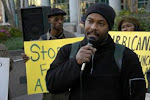
The New Afrikan Women Caucus (NAWC) of the Malcolm X Grassroots Movement (MXGM) of Atlanta stands in solidarity with Spark Reproductive Justice NOW!, SisterSong Inc., and SisterLove and the Trust Black Women Coalition’s campaign to stop the disruptive tactics of a injudicious and corruptive anti-choice agenda. The attacks of the so-called “freedom rides” organized by right-wing pundits Glenn Beck and Adventa King, follow a time tested pattern of divide and conquer and use and exploit our communities to further an exclusive political agenda. We reject the hijacking of the historical narrative of our people’s struggle from white supremacy and apartheid and distort our victories against these oppressive systems.
One of the central principles of the Malcolm X Grassroots Movement is the right of self-determination. We understand the recent and historical attacks of the right-wing, anti-choice movement against women, and Black women in particular, to be nothing less than an attempt to stifle the progress and gains of the women’s and reproductive justice movements.
The attempt to appropriate the name and images of the “Freedom Rides” of the 1960’s with the conservative political agenda of the anti-choice movement is offensive and dangerous. This right-wing “joy riding” appropriation is a distracting ploy to draw attention away from their true agenda. Their goal is to reverse the critical gains of the civil rights movement and restore the power of a patriarchial state over women’s bodies.
The messaging of the anti-choice movement is so distorted and manipulative that it often deceives elements in our communities, particularly the more spiritually observant sectors. This old agenda with new tactics appears to be more “compassionate,” more “concerning,” and promises outcomes that would support and strengthen Black communities. Not only is this not true, it is not their intent. Their objective is to divide the Black community and weaken our political power – concentrated power that when united, can defeat the agenda of the right.
Black and all oppressed people must unite and stand in firm opposition to this agenda and its manipulative ploys. We must end the legacies of colonialism and white supremacy rooted in the US empire which was built on the very ownership and manipulation of our bodies. We must demand self-determination and the unequivocal control over our own bodies. We will not be subjected to the oppressive whims of a white supremacist, patriarchial state!
The struggle for reproductive justice must be central to all the peoples’ struggles – Black, Indigenous, Puerto Rican, Hawaiian, Latino, Asian, etc. – struggling for justice in the US. Self-determination and liberation comes with having power over ourselves, our families, our communities, and our bodies. Weak ploys of an anti-choice agenda by anti-reproductive justice conservatives will not be allowed to gain further ground in our communities.
Now is the time to educate, agitate and organize to defend our bodies, realize our human rights and defeat this right-wing assault on our people and community.
We say
FREE THE BODY,
FREE THE MIND
FREE THE LAND!
Wednesday, July 28, 2010


Open Letter to Justice to Oscar Grant Movement, Part 2: Suggestions on Structure, People's Tribunal, and utilizing the UPR Process
This letter was drafted in response to inquiries on a national phone call on the struggle for Justice for Oscar Grant organized by Davey D, Biko Baker, and the League of Young Voters on Wednesday, July 21st.
Greetings All,
Per our discussion regarding next steps on the July 21st call I wanted to offer several suggestions to the group to consider.
On Structure: The US Human Rights Network (USHRN) has been in the process of forming a National Alliance for Racial Justice and Human Rights (NARJHR) since the summer of 2009. This Alliance was initiated by Network members the Malcolm X Grassroots Movement, Black Workers for Justice, Mississippi Workers Center for Human Rights, Center for Constitutional Rights, Latin American and Caribbean Community Center, and others, and is seeking to focus on the following racial justice issues and struggles:
Indigenous sovereignty
Colonial occupation (Puerto Rico, Hawaii, Guam, etc.)
Racial Profiling
Police Brutality
Mass Incarceration (including Drug Policy and Voting Rights)
Immigration
Workers Rights
Economic Justice
Gender and Reproductive Justice
Environmental Racism
Given that we began to address a comprehensive framework that touched on most, if not all of these issues, the Network and the NARJHR Organizing Committee - of which I am a member - offer its framework and incipient structure to this collective as something to consider to help sustain and build this initiative. For more information on the National Alliance please visit http://019d5f5.netsolhost.com/NARJHR/ (please note that this site is currently under construction and is in the process of being transferred to the new USHRN hosting site).
On National Campaign(s): To answer the questions, a) how can we can link our various local efforts and initiatives and b) what are we demanding of the government that will address our issues and begin to transform the relations of power underneath them, I want to point to the following example as something to both model and join. The example comes from a campaign initiative being lead by the Rights Working Group (RWG), a USHRN affiliate, to confront Racial Profiling. The campaigns primary objective is to pass the national “End of Racial Profiling Act” being reintroduced in Congress. For more information see the following link http://www.rightsworkinggroup.org/sites/default/files/ERPA_IssueBrief.pdf. Again, I think this provides us with an excellent concrete example of what can do by combining our efforts.
On the Tribunal Proposal: Building on the groundwork laid on the case of Oscar Grant in Oakland, CA from the Tribunals conducted by the African People's Socialist Party (APSP) and By Any Means Necessary Coalition (BAMN), what me and Davey D want to put forward is a Tribunal proposal that will a) provide clear evidence and contextualization on Oscar Grants murder to pressure the DOJ, b) create space to address the national implications of the murder and the policies that enabled it to help build a national alliance and/or coalition, and 3) internationalize the struggle by including participants such as the UN Special Rapporteur on Racism and the Universal Periodic Review Process (see below) to further pressure the DOJ and the US government in general to make various reforms. Further, building on the models of the International Tribunal on Hurricanes Katrina and Rita in 2007 and Winter Solider in 2008, we want to put forth the following outline:
That we make the Tribunal as simple as possible, but scale it up utilizing interactive technology, to make it affordable and accessible to a broad audience.
That we invite international participants, like the Special Rapportuer on Racism, to be involved and include them in the proceedings via technology like Skype, etc.
That we base the Tribunal proceedings on human rights and/or international law practices.
That we conduct the Tribunal over a three day period, conceptually broken down in the following manner:
· Day One: Testimony, focusing on Oscar Grant and other cases of Police Brutality and Murder
· Day Two: Examining and exposing the Structural Issues, i.e. Racial Profiling, Mass Incarceration, ICE Raids, Structural Un/Under Employment, etc.
· Day Three: Demands, Recommendations, and Solutions, to press upon the US government and the UN
To give ourselves enough time, and hopefully tap into existing institutions of resistance, we suggest that we aim to conduct the Tribunal on or around October 22nd. This would give us two full months (August and September) to organize and coordinate the effort and to publicize it nationally to a considerable degree. However, this developing alliance, but most particularly the forces on the ground in California, would need to come to terms on conducting such an event and then figure out a) who the potential organizing anchors would be and b) how to generate the resources necessary to engage in such an undertaking.
For more information on the Special Rapporteur on Racism and the mandate of the office please visit http://www2.ohchr.org/english/issues/racism/rapporteur/index.htm. For information on previous engagements of the Special Rapporteur on Racism with US social movements visit http://www.ushrnetwork.org/special_rep.
On the UPR Day/Week of Action: The UPR stands for the Universal Periodic Review. It is a relatively new process of the United Nations country reporting system to evaluate the conduct of the world nations towards meeting their obligations to respect, protect, and fulfill human rights. The United States is being subjected to its first UPR review on Friday, November 5th in Geneva, Switzerland. The human rights record of the US will be presented and defended by Secretary of State Hilary Clinton and Attorney General Eric Holder. As I'm sure everyone has noted, this is the same date that Johannes Mehserle is currently set to be sentenced. And with Eric Holder, the head of the DOJ, being a primary presenter, this process provides us with an excellent opportunity to both shame the US government on its inadequate polices and conduct and to pressure the DOJ, and the government on a whole, to make concrete progressive reforms based on our demands.
To fully exploit this opportunity what is being suggested is a national day and/or week of action between November 1st - 4th to influence the Mehserle sentencing proceedings directly and the US's UPR hearing process. Suggested actions would entail:
1. Teach-In's,
2. Congressional Lobbying
3. Mass Demonstrations on relevant targets
4. Direct Actions also on relevant targets (Justice Department, Federal Courts, etc.).
Critical to the success of this initiative would be the generation of national and international media. Our media and cultural workers would need to form a solid plan to support, document, and report the activities of this week to ensure there was broad coverage to pressure the government.
For more information on the UPR please visit the following websites http://www.ushrnetwork.org/campaign_upr and http://www.upr-info.org/-United-States-.html.
In Unity and Struggle,
Kali Akuno
Monday, July 26, 2010
Greetings All,
Per our discussion regarding next steps on the July 21st call I wanted to offer several suggestions to the group to consider.
On Structure: The US Human Rights Network (USHRN) has been in the process of forming a National Alliance for Racial Justice and Human Rights (NARJHR) since the summer of 2009. This Alliance was initiated by Network members the Malcolm X Grassroots Movement, Black Workers for Justice, Mississippi Workers Center for Human Rights, Center for Constitutional Rights, Latin American and Caribbean Community Center, and others, and is seeking to focus on the following racial justice issues and struggles:
Indigenous sovereignty
Colonial occupation (Puerto Rico, Hawaii, Guam, etc.)
Racial Profiling
Police Brutality
Mass Incarceration (including Drug Policy and Voting Rights)
Immigration
Workers Rights
Economic Justice
Gender and Reproductive Justice
Environmental Racism
Given that we began to address a comprehensive framework that touched on most, if not all of these issues, the Network and the NARJHR Organizing Committee - of which I am a member - offer its framework and incipient structure to this collective as something to consider to help sustain and build this initiative. For more information on the National Alliance please visit http://019d5f5.netsolhost.com/NARJHR/ (please note that this site is currently under construction and is in the process of being transferred to the new USHRN hosting site).
On National Campaign(s): To answer the questions, a) how can we can link our various local efforts and initiatives and b) what are we demanding of the government that will address our issues and begin to transform the relations of power underneath them, I want to point to the following example as something to both model and join. The example comes from a campaign initiative being lead by the Rights Working Group (RWG), a USHRN affiliate, to confront Racial Profiling. The campaigns primary objective is to pass the national “End of Racial Profiling Act” being reintroduced in Congress. For more information see the following link http://www.rightsworkinggroup.org/sites/default/files/ERPA_IssueBrief.pdf. Again, I think this provides us with an excellent concrete example of what can do by combining our efforts.
On the Tribunal Proposal: Building on the groundwork laid on the case of Oscar Grant in Oakland, CA from the Tribunals conducted by the African People's Socialist Party (APSP) and By Any Means Necessary Coalition (BAMN), what me and Davey D want to put forward is a Tribunal proposal that will a) provide clear evidence and contextualization on Oscar Grants murder to pressure the DOJ, b) create space to address the national implications of the murder and the policies that enabled it to help build a national alliance and/or coalition, and 3) internationalize the struggle by including participants such as the UN Special Rapporteur on Racism and the Universal Periodic Review Process (see below) to further pressure the DOJ and the US government in general to make various reforms. Further, building on the models of the International Tribunal on Hurricanes Katrina and Rita in 2007 and Winter Solider in 2008, we want to put forth the following outline:
That we make the Tribunal as simple as possible, but scale it up utilizing interactive technology, to make it affordable and accessible to a broad audience.
That we invite international participants, like the Special Rapportuer on Racism, to be involved and include them in the proceedings via technology like Skype, etc.
That we base the Tribunal proceedings on human rights and/or international law practices.
That we conduct the Tribunal over a three day period, conceptually broken down in the following manner:
· Day One: Testimony, focusing on Oscar Grant and other cases of Police Brutality and Murder
· Day Two: Examining and exposing the Structural Issues, i.e. Racial Profiling, Mass Incarceration, ICE Raids, Structural Un/Under Employment, etc.
· Day Three: Demands, Recommendations, and Solutions, to press upon the US government and the UN
To give ourselves enough time, and hopefully tap into existing institutions of resistance, we suggest that we aim to conduct the Tribunal on or around October 22nd. This would give us two full months (August and September) to organize and coordinate the effort and to publicize it nationally to a considerable degree. However, this developing alliance, but most particularly the forces on the ground in California, would need to come to terms on conducting such an event and then figure out a) who the potential organizing anchors would be and b) how to generate the resources necessary to engage in such an undertaking.
For more information on the Special Rapporteur on Racism and the mandate of the office please visit http://www2.ohchr.org/english/issues/racism/rapporteur/index.htm. For information on previous engagements of the Special Rapporteur on Racism with US social movements visit http://www.ushrnetwork.org/special_rep.
On the UPR Day/Week of Action: The UPR stands for the Universal Periodic Review. It is a relatively new process of the United Nations country reporting system to evaluate the conduct of the world nations towards meeting their obligations to respect, protect, and fulfill human rights. The United States is being subjected to its first UPR review on Friday, November 5th in Geneva, Switzerland. The human rights record of the US will be presented and defended by Secretary of State Hilary Clinton and Attorney General Eric Holder. As I'm sure everyone has noted, this is the same date that Johannes Mehserle is currently set to be sentenced. And with Eric Holder, the head of the DOJ, being a primary presenter, this process provides us with an excellent opportunity to both shame the US government on its inadequate polices and conduct and to pressure the DOJ, and the government on a whole, to make concrete progressive reforms based on our demands.
To fully exploit this opportunity what is being suggested is a national day and/or week of action between November 1st - 4th to influence the Mehserle sentencing proceedings directly and the US's UPR hearing process. Suggested actions would entail:
1. Teach-In's,
2. Congressional Lobbying
3. Mass Demonstrations on relevant targets
4. Direct Actions also on relevant targets (Justice Department, Federal Courts, etc.).
Critical to the success of this initiative would be the generation of national and international media. Our media and cultural workers would need to form a solid plan to support, document, and report the activities of this week to ensure there was broad coverage to pressure the government.
For more information on the UPR please visit the following websites http://www.ushrnetwork.org/campaign_upr and http://www.upr-info.org/-United-States-.html.
In Unity and Struggle,
Kali Akuno
Monday, July 26, 2010
Thursday, July 15, 2010
An Open Letter to the Justice for Oscar Grant Movement: Suggestions on Next Steps, Strategy and Unity Building

By Kali Akuno
National Organizer - Malcolm X Grassroots Movement
Director of Education, Training, and Field Operations – US Human Rights Network
The righteous anger and indignation on graphic display in Oakland, California Thursday, July 8th at the mockery of justice rewarded to Johannes Mehserle for murdering Oscar Grant and the open collaboration of several non-profit organizations with the government to contain and delegitimatize the people’s resistance is a clarion call. It’s a call not just for justice for Oscar Grant and the countless victims of police terror, but for radical, systemic change. The anger, and its focus, indicates a heightened awareness on behalf of a new generation of working class Black, Latino and Asian youth of the intractable contradictions between the imperialist state and oppressed peoples and the willingness to challenge them.
A new phase of development and a new set of challenges now confront the movement to win justice for Oscar Grant. The inexperience of the youth forces engaged and the current weaknesses and fragmentation of the left make this a very, very delicate time. If certain conversations aren’t had, if certain lessons of the past and present aren’t incorporated, and if certain contradictions aren’t addressed, then all of the radiant energy on display July 8th could easily fade, or just as easily turn its wrath in upon itself and miss its true target.
This small contribution is an attempt to help ignite conversation, share reflections from critical movements of the past, and offer suggestions in the hope of helping to facilitate strategic and programmatic development within the movement.
On Next Steps and Organizing Orientation
1. Joint Reflection: to move the Justice for Oscar Grant Movement forward progressive forces focused on building the democratic mass movement, should join forces and come together to assess the strengths and weaknesses of the Justice for Oscar Grant Movement over the past year and half. One of the two main objectives of such a collaboration, in the short term, would be to produce a joint assessment and a unified set of demands, both tactical and strategic, to help anchor the movement in its next phase of struggle.
2. Joint Assessment: This assessment should be issued as a statement and/or document that provides a clear analysis of the movements weaknesses and errors and some strong points of orientation to try and anchor, sustain, and guide it going forward. Some key points of assessment should include (but not be limited to) the following:
a) A firm condemnation of collaboration and opportunism; but avoiding personalized vilification of the social forces that collaborated (being mindful of the lessons of COINTELPRO)
b) A statement of distinction on the role of political and community organizations as opposed to non-profits; and clarity on the reformist orientation and political limitations of non-profit organizations
c) The function of organization in the movement to combat infiltration (as appears to have occurred within the Black Bloc and other formations)
d) The need for strategy to help facilitate forward development and political advancement of the movement(s)
3. Joint Strategy and Work Plan: The second primary objective of such a collaboration would be to draft a one-year strategy and work plan to realize the unified demands that are put forward to the movement to democratically accept (understanding the independence of initiative of each formation), modify, or categorically reject.
This convergence of forces, although necessarily centered in California, particularly the Bay Area and Los Angeles, should seek to build and consolidate a national and international organizing initiative.
On Demand Expansion and Development
1. The opening of a Federal Investigation by the Department of Justice (DOJ) can and should be used as a national organizing opportunity. However, more self-determining justice initiatives should be organized simultaneously to challenge US hegemony (internally and externally) by internationalizing the struggle. More concretely, an independent “people’s or citizens” commission should be established to conduct an autonomous examination of the evidence, issue indictments, and pressure the DOJ and its process. This commission would ideally consist of family members, community activists, lawyers, jurists, etc. and call on various international bodies within the United Nations (UN) and International System (such as the Inter-American Court) to intervene in the case and challenge the racist policies and practices that enabled it.
2. The demand for resources and economic development must be supported unequivocally, but modified in a manner that puts limits on the controls of City Hall and its near exclusive access by “grasstop” forces. A means to accomplishing this (not without its faults or limits by any stretch) could be the institutionalization of participatory budgeting systems to determine the use of the cities resources to ensure they are used to address and service human needs such as adequate housing, health care, education, etc.
Synthesis Demands
This synthesis is an attempt to combine and expand on the demands originally articulated by the African People’s Socialist Party (APSP), By Any Means Necessary (BAMN) Coalition, and the New Years Movement (NYM).
1. We demand that Officers Pirone and Domenici be indicted for murder.
2. We demand civil restitution and reparations for the family Oscar Grant, and the victims of Police violence by the OPD and BART.
3. We demand that BART Police be disarmed and disbanded.
4. We demand that the Police Bill of Rights, which shields the records of police misconduct, abuse and murder, be immediately abolished, and that all police records be made public.
5. We demand that an independent “peoples commission”, drawn and determined by the citizens of Oakland, with international jurists determined by this commission, be granted oversight into the Federal Department of Justice investigation of the murder of Oscar Grant, and systemic violations of civil and human rights by the Oakland and Transit Police.
6. We demand the termination of all Gang Injunction laws and policies in Oakland and throughout California on the grounds of their unconstitutionality and their violation of civil and international law.
7. We demand that Oakland be declared a sanctuary city, and that all ICE raids and racial profiling policies and practices targeting Latino/a, Black, Asian and other oppressed peoples be terminated immediately.
8. We demand that the City of Oakland, the State of California, and the Federal Government provide massive funding for education and jobs in Oakland that are allocated and distributed via a transparent and democratic public participatory budgeting process.
One-Year Plan Targets/Tactics
1. Conduct a mass and coordinated non-compliance action in Oakland and Los Angeles the day after Mehserle’s sentencing, that calls for Student walk outs and strike or “sick out” actions by Public Sector, Transit, Dock, and other workers that disrupts the regular flow of “business” to raise our demands and demonstrate the power of mass action.
2. Organize broad, neighborhood Police/Copwatch formations, and work to create “liberated zones” in Black, Latino, Asian, and white working class and poor communities, where the police are prohibited or curtailed in their activities.
3. Organize a massive local, regional, statewide, and national “Justice for Oscar Grant” petition drive to pressure the DOJ and build support for the movement’s demands (buttressed by broad internet and social networking interface to support and broaden reach).
4. Develop a broad people’s media and cultural workers initiative to provide educational, motivational, and agitation tools and resources for the movement and to provide sufficient analysis and coverage to frame the movement from its own perspective and counter the reactionary framing and attacks of the bourgeois media.
5. Hold a People’s Tribunal, with international observers and jurists, to pressure the DOJ and its deliberations.
6. Utilize Inter-American and United Nations special action procedures and special rapporteurs to conduct international investigations, recommendations, and sanctions on the US government for its failure to protect the human rights of Oscar Grant, the victims of police violence, and the targets of the various racial profiling laws and policies sanctioned by the government.
7. Organize local, state and national referendum and legislative initiatives to realize and support the movement’s demands. A possible start could entail running progressive candidates in Oakland who stand on a platform based on the movement’s demands in the upcoming elections to help define public debate and pressure the government to comply.
Without a doubt, accomplishing all of this is a tall order, particularly for a young and fragmented movement. But, as the history of the peoples’ struggles against white supremacy, colonialism, and imperialism here and all over the world demonstrate, no political challenges are insurmountable. If we dare to win, then we must dare to struggle against the internal shortcomings and subjectivities of the movement that hinder us from building the operational unity needed to execute initiatives of scale such as those proposed in this paper. The struggle for unity does not mean that we should stop struggling against collaborationist and opportunist ideas and practices. It simply implores us to do all we can to seize the opportunities at hand. With organization, strategy, discipline, and determination we can and will win!
In Unity and Struggle.
Thursday, July 15, 2010
Kali can be contacted via kaliakuno@gmail.com.
Monday, May 3, 2010
Land and Housing Action Group Working Paper #3: The Meaning of the Slogan, the Meaning of the Movement

The Take Back the Land slogan is a cry for social justice drawn from the historic anti-colonial and popular struggles of the Third World, or Global South, and the Peoples’ Movements within the US, particularly Indigenous, Black, Chicano, Puerto Rican, and Hawaiian struggles for land, treaty rights, self-determination and sovereignty.
The Land and Housing Action Group (LHAG) issued the campaign call initiating the present-day Take Back the Land Movement to honor and build on the critical historic and structural demands of these peoples’ movements. We stand on an anti-settler position, which acknowledges that first and foremost all the lands currently held and/or claimed by the US government rightfully belong their indigenous inhabitants, not to European settlers and their descendents who acquired them through genocidal conquest and thievery. Further we stand opposed to the system of land commodification and private possession initiated by European colonization and institutionalized and enshrined within the US constitution and legal custom.
The ultimate, long-term objective of the Take Back the Land Movement is to end this system of land commodification. We call this the decommodification imperative. This imperative is rooted in the belief that in order for the human right to adequate housing to be realized there must be a radical transformation in how land is related to and used. If the present system and orientation is maintained it undoubtedly will lead to further wealth polarization, displacement, social unrest, food insecurity, water conflicts, deforestation, and species loss. To avoid these calamities a new orientation and system must be created that rebuilds the “commons”, is based in communal ownership and economic democracy, and rooted in a relational inter-species approach to land that respects the inherent rights of “all our relations” to enjoy the earth’s bounty.
We recognize that we have many a river to cross in what will undoubtedly be a protracted struggle before realizing substantive change on this issue. Notions of individual home ownership are central to the narrative of the “American Dream”. Challenging the ideological and amoral underpinning of this narrative won’t be easy, even in historically oppressed communities. But, it must be done as a critical step in the struggle to help save ourselves from ourselves and avert the potential catastrophe of ecocide from the over consumption of the earth’s resources. The initiative to build a mass direct action movement through the action initiatives of May 2010 and beyond is just a first critical step on this journey.
The Land and Housing Action Group invite’s everyone to join us in advancing this vision and realizing its potential. We aim to not just correct historical wrongs, but to build a more just and equitable society for all.
Build the Take Back the Land Movement to realize our human right to adequate housing.
For more information on how you can join or support the Take Back the Land campaign, email housingrights@ushrnetwork.org or call 404.588.9761.
Land and Housing Action Group Working Paper #2: Identifying, Occupying, and Transforming “Un-identified” Public Housing

Over 3 million homes were foreclosed in 2009. More than 2.4 million are expected in 2010. With the 3 million recorded in 2008, an outrageous 8.4 million plus homes have been foreclosed in the span of 3 years.
Obama’s mortgage modification program has fundamentally failed to save millions of families from losing their homes. The only thing the Troubled Asset Relief Program (TARP) has accomplished is saving the banks and restoring their profits. Meanwhile millions have joined the ranks of the “hidden homeless” while millions of homes sit vacant on the warehousing rolls of the banks and the government.
In November 2009, the Land and Housing Action Group (LHAG) of the US Human Rights Network (USHRN) stated that all the houses cleared for the Banks via TARP constituted public housing as they were purchased with public funds. Building on this position, we demand that all homes and housing units currently being warehoused by the banks and the government be publicly identified and opened to occupation by the millions of families displaced from their homes and the tens of thousands languishing on public and/or affordable housing waiting lists.
The United States government is obligated under international law to respect, protect, and fulfill the human right to adequate housing for all persons residing within the confines of its jurisdiction. Publicly identifying vacant housing stock suitable for occupation is an immediate means for the US government to begin fulfilling its obligations. But, this is just a starting place. Further steps must be taken to protect families and communities from biased policies and the arbitrary dictates of the financial markets.
The Land and Housing Action Group maintains that one of the critical next steps that must to be taken is transforming the vast stock of vacant homes into cooperative housing and land trusts to be directly governed and administered on a local level by impacted families and communities. We believe direct management is essential to avoid the destruction of public housing goods or its deformation into private possessions utilized strictly to generate individual profit.
The Land and Housing Action Group calls on all those of good conscience to join us in raising the demand that all vacant housing purchased with pubic funds be identified as un-utilized public housing stock and employed immediately to provide housing to those in need. The realization of the human right to housing in the United States demands no less. Build the Take Back the Land Movement to realize our human right to adequate housing.
For more information on how you can join or support the Take Back the Land campaign, email housingrights@ushrnetwork.org or call 404.588.9761.
Groups Take Back the Land During May 2010 Month of Action
May 3, 2010- Today, the Take Back the Land Movement (TBLM, www.takebacktheland.org) announced a May 2010 Month of Action in direct response to the ongoing economic and housing crisis. The month of action commemorates the 50th anniversary of the first Civil rights era sit-ins in Greensboro, NC. Thousands from across the country will participate in “live-ins” to demand the fundamental human right to housing. Groups in over a dozen cities across the country will move families into vacant government-owned and foreclosed homes, without permission, or physically defend families from eviction and foreclosure.
The objective of the coordinated civil disobedience campaigns is to build a national movement to elevate housing to the level of a human right and gain community control over land.
“We are defending families facing eviction and moving homeless people into people-less homes,” said Max Rameau of Take Back the Land. “While banks enjoy bailouts, executive bonuses and record profits, human beings and entire communities are suffering. The government does not appear interested in helping poor people, so we have no other choice.”
The TBLM is a network of community organizations or initiatives committed to community control over land and housing as a human right. The Movement receives national staffing and administrative support from the US Human Rights Network (ushrnetwork.org) and is organized in conjunction with the Poor People's Economic Human Rights Campaign (PPEHRC) (economichumanrights.org), an organization with a long history of housing takeovers and defenses.
Right 2 Survive, a Portland, Oregon based which empowers un-sheltered persons, seized control of a vacant lot in front of a long abandoned high school at 531 SE 14th Ave. in South Portland on May 1. Media coverage of the action is available at right2survive.wordpress.com and takebacktheland.org.
In Toledo, OH, Keith Sadler of Stony Ridge is due to be evicted from his home today (May 3). But Mr. Sadler intends to resist the foreclosure and stay in his home. “I am resisting this eviction through non-violent civil disobedience,” stated Sadler. “It's time to make a stand against this corrupt system.” The Toledo Foreclosure Defense League, a Northwest Ohio coalition of anti-foreclosure activists, will stand by Mr. Sadler to defend his home. Sadler and the Toledo Foreclosure Defense League will peacefully occupy the foreclosed home by sealing themselves inside until the foreclosure is called off and a moratorium on all residential foreclosures is enacted. A live video feed from inside the house will be provided online.
Actions are also expected on May 3rd in Chicago, IL, where the Chicago anti-eviction campaign is protesting the HUD offices, 77 W Jackson, at 11:00am, and in Philadelphia, PA by the Kensington Welfare Rights Union. Throughout the month, actions are expected in every region of the country, including in the:
Northeast: Boston, MA; New York, NY; Philadelphia, PA; and Washington, DC
South: Louisville, KY; New Orleans, LA; St. Petersburg, FL; and Miami, FL
Midwest: Chicago, IL; Toledo, OH; Madison, WI; Detroit, MI; and Minneapolis, MN
West: Portland, OR
Details about upcoming actions are available at www.takebacktheland.org.
Housing is a fundamental human right protected by Article 25 of the Universal Declaration of Human Rights (UDHR), Article 11 of the International Covenant on Economic, Social, and Cultural Rights (CESCR), and Article 5 of the International Convention on the Elimination of All Forms of Racial Discrimination (CERD), amongst others. In the context of the severe housing crisis and the multi-billion dollar bailout of the financial industry, participating organizations demand the US government enforce their international responsibilities and obligations to protect and fulfill this basic human right.
Take Back the Land - Miami started in October 2006 by seizing control over a vacant municipal lot in Miami, FL and building the Umoja Village Shantytown. Subsequent campaigns resulted in “liberating” and moving families into foreclosed homes, without permission from the banks.
The Poor People's Economic Human Rights Campaign was founded in 1998 and is committed to unite the poor across color lines as the leadership base for a broad movement to abolish poverty by advancing economic human rights as named in the Universal Declaration of Human Rights, such as the rights to food, housing, health, education, communication and a living wage job.
Civil Disobedience training support is provided by the Ruckus Society (www.ruckus.org) and legal support is provided by the Center for Constitutional Rights (www.ccrjustice.org).
Contacts:
Take Back the Land (www.takebacktheland.org)
Max Rameau takebacktheland@gmail.com 786-231-3446
Ajamu Baraka abaraka@ushrnetwork.org 404-588-9761
Poor People's Economic Human Rights Campaign (www.economichumanrights.org)
Cheri Honkala cherihonkalappehrc@gmail.com 267-439-8419
Rosemary Nevils Williams rosemarynevils@yahoo.com 612-296-3481
The objective of the coordinated civil disobedience campaigns is to build a national movement to elevate housing to the level of a human right and gain community control over land.
“We are defending families facing eviction and moving homeless people into people-less homes,” said Max Rameau of Take Back the Land. “While banks enjoy bailouts, executive bonuses and record profits, human beings and entire communities are suffering. The government does not appear interested in helping poor people, so we have no other choice.”
The TBLM is a network of community organizations or initiatives committed to community control over land and housing as a human right. The Movement receives national staffing and administrative support from the US Human Rights Network (ushrnetwork.org) and is organized in conjunction with the Poor People's Economic Human Rights Campaign (PPEHRC) (economichumanrights.org), an organization with a long history of housing takeovers and defenses.
Right 2 Survive, a Portland, Oregon based which empowers un-sheltered persons, seized control of a vacant lot in front of a long abandoned high school at 531 SE 14th Ave. in South Portland on May 1. Media coverage of the action is available at right2survive.wordpress.com and takebacktheland.org.
In Toledo, OH, Keith Sadler of Stony Ridge is due to be evicted from his home today (May 3). But Mr. Sadler intends to resist the foreclosure and stay in his home. “I am resisting this eviction through non-violent civil disobedience,” stated Sadler. “It's time to make a stand against this corrupt system.” The Toledo Foreclosure Defense League, a Northwest Ohio coalition of anti-foreclosure activists, will stand by Mr. Sadler to defend his home. Sadler and the Toledo Foreclosure Defense League will peacefully occupy the foreclosed home by sealing themselves inside until the foreclosure is called off and a moratorium on all residential foreclosures is enacted. A live video feed from inside the house will be provided online.
Actions are also expected on May 3rd in Chicago, IL, where the Chicago anti-eviction campaign is protesting the HUD offices, 77 W Jackson, at 11:00am, and in Philadelphia, PA by the Kensington Welfare Rights Union. Throughout the month, actions are expected in every region of the country, including in the:
Northeast: Boston, MA; New York, NY; Philadelphia, PA; and Washington, DC
South: Louisville, KY; New Orleans, LA; St. Petersburg, FL; and Miami, FL
Midwest: Chicago, IL; Toledo, OH; Madison, WI; Detroit, MI; and Minneapolis, MN
West: Portland, OR
Details about upcoming actions are available at www.takebacktheland.org.
Housing is a fundamental human right protected by Article 25 of the Universal Declaration of Human Rights (UDHR), Article 11 of the International Covenant on Economic, Social, and Cultural Rights (CESCR), and Article 5 of the International Convention on the Elimination of All Forms of Racial Discrimination (CERD), amongst others. In the context of the severe housing crisis and the multi-billion dollar bailout of the financial industry, participating organizations demand the US government enforce their international responsibilities and obligations to protect and fulfill this basic human right.
Take Back the Land - Miami started in October 2006 by seizing control over a vacant municipal lot in Miami, FL and building the Umoja Village Shantytown. Subsequent campaigns resulted in “liberating” and moving families into foreclosed homes, without permission from the banks.
The Poor People's Economic Human Rights Campaign was founded in 1998 and is committed to unite the poor across color lines as the leadership base for a broad movement to abolish poverty by advancing economic human rights as named in the Universal Declaration of Human Rights, such as the rights to food, housing, health, education, communication and a living wage job.
Civil Disobedience training support is provided by the Ruckus Society (www.ruckus.org) and legal support is provided by the Center for Constitutional Rights (www.ccrjustice.org).
Contacts:
Take Back the Land (www.takebacktheland.org)
Max Rameau takebacktheland@gmail.com 786-231-3446
Ajamu Baraka abaraka@ushrnetwork.org 404-588-9761
Poor People's Economic Human Rights Campaign (www.economichumanrights.org)
Cheri Honkala cherihonkalappehrc@gmail.com 267-439-8419
Rosemary Nevils Williams rosemarynevils@yahoo.com 612-296-3481
Wednesday, April 21, 2010
Endorse the Take Back the Land Movement
Greetings All,
The historic month of May 2010 is rapidly dawning upon us. In addition to honoring International Workers’ Day and continuing to press for the right to dignity at work and legalization for all, this May Day will also serve as the commencement of the Take Back the Land Campaign. Beginning in May, communities and activists throughout the country will be engaging in autonomous direct actions throughout the country to realize the human right to housing and build the Take Back the Land Movement.
We want to encourage everyone of good conscience to join and help build this critical movement. Millions of families and communities are being displaced by the privatization of public housing, the deepening of the foreclosure crisis, and the escalation of homelessness and we cannot remain silent in the face of these injustices.
We are appealing for you and your organization to endorse the Take Back the Land Movement and support us in pressing for the following principles and demands.
1. That Housing is a fundamental human right that the US government has an obligation to respect, protect, and fulfill.
2. That in order to realize this right, the conditions of our time necessitate that we must build a mass movement to press our demands, and that non-violent direct action is a principle means of pressing them.
Further, we encourage all those who endorse to support the building of this movement in one or more of the following ways:
1. Conduct a demonstration in your local area against one of the major banks (Wells Fargo, Bank of America, Citibank, JP Morgan Chase, etc.) or the Department of Housing and Urban Development (HUD) linked to the principles and demands of the Take Back the Land Movement.
2. Conduct a community forum or teach-in about the Take Back the Land Movement to educate the people in your community, work place, place of worship, or school about this initiative and its importance.
3. Write an article or op-ed about the Take Back the Land Movement to submit to your local newspaper, or your organizations newsletter, journal or magazine to help educate the public and help build this critical movement.
4. Conduct a fundraiser in your area to help the Land and Housing Action Group provide training and technical support to Local Action Groups in the development of their actions and movement building activities. Donations can be made via Paypal at www.ushrnetwork.org or via check to US Human Rights Network, c/o the Land and Housing Action Group. Mail to US Human Rights Network 250 Georgia Ave. Suite 330, Atlanta, GA 30312.
To endorse and join the Take Back the Land Movement please email housingrights@ushrnetwork.org. And specify if you are endorsing as an individual or as an organization. For further information visit www.ushrnetwork.org or www.takebacktheland.org.
In Unity and Struggle,
The Land and Housing Action Group
Wednesday, April 21, 2010
The historic month of May 2010 is rapidly dawning upon us. In addition to honoring International Workers’ Day and continuing to press for the right to dignity at work and legalization for all, this May Day will also serve as the commencement of the Take Back the Land Campaign. Beginning in May, communities and activists throughout the country will be engaging in autonomous direct actions throughout the country to realize the human right to housing and build the Take Back the Land Movement.
We want to encourage everyone of good conscience to join and help build this critical movement. Millions of families and communities are being displaced by the privatization of public housing, the deepening of the foreclosure crisis, and the escalation of homelessness and we cannot remain silent in the face of these injustices.
We are appealing for you and your organization to endorse the Take Back the Land Movement and support us in pressing for the following principles and demands.
1. That Housing is a fundamental human right that the US government has an obligation to respect, protect, and fulfill.
2. That in order to realize this right, the conditions of our time necessitate that we must build a mass movement to press our demands, and that non-violent direct action is a principle means of pressing them.
Further, we encourage all those who endorse to support the building of this movement in one or more of the following ways:
1. Conduct a demonstration in your local area against one of the major banks (Wells Fargo, Bank of America, Citibank, JP Morgan Chase, etc.) or the Department of Housing and Urban Development (HUD) linked to the principles and demands of the Take Back the Land Movement.
2. Conduct a community forum or teach-in about the Take Back the Land Movement to educate the people in your community, work place, place of worship, or school about this initiative and its importance.
3. Write an article or op-ed about the Take Back the Land Movement to submit to your local newspaper, or your organizations newsletter, journal or magazine to help educate the public and help build this critical movement.
4. Conduct a fundraiser in your area to help the Land and Housing Action Group provide training and technical support to Local Action Groups in the development of their actions and movement building activities. Donations can be made via Paypal at www.ushrnetwork.org or via check to US Human Rights Network, c/o the Land and Housing Action Group. Mail to US Human Rights Network 250 Georgia Ave. Suite 330, Atlanta, GA 30312.
To endorse and join the Take Back the Land Movement please email housingrights@ushrnetwork.org. And specify if you are endorsing as an individual or as an organization. For further information visit www.ushrnetwork.org or www.takebacktheland.org.
In Unity and Struggle,
The Land and Housing Action Group
Wednesday, April 21, 2010
Subscribe to:
Posts (Atom)

 Posts
Posts