Linking the Struggles: Amilcar Cabral and his impact and legacy in the
Black Liberation Movement
Part 1
Kali Akuno
December 2012
Keep always in mind that the people are not fighting
for ideas, for the things in anyone’s head. They are fighting…..for material benefits,
to live better and in peace, to see their lives go forward, to guarantee the
future of their children. National Liberation, War on Colonialism, building of
peace and progress – independence – all that will remain meaningless for the
people unless it brings a real improvement in the conditions of life.
Amilcar Cabral, from “Destroy the economy of the enemy
and build our own economy”, 1965.
Since the close Fifth Pan-African Congress in Manchester,
England and the end of the second great inter-imperialist war (better known as
World War II) in 1945, the radical-wing of the Black Liberation Movement in the
United States (US) has been inspired by and drawn many lessons from its
reciprocal interactions with the national and social liberation movements of
Africa (primarily from 1945 through 1994) and the Diaspora (particularly those
of the Caribbean).
The Black Liberation Movement or BLM is the historic movement
of people of African descent within the territories now occupied and claimed by
the settler-colonial government of the United States for self-determination and
social liberation in three primary (and often mutually inclusive) forms
:
·
Repatriation back to Africa
·
The creation of a sovereign, independent
national-state for Black or New Afrikan people in the southeastern portion of
what is presently the United States
·
The socialist and/or anti-capitalist
transformation of the United States by an anti-racist, anti-imperialist
multi-national alliance
The radical elements of the BLM - composed primarily of
revolutionary nationalists, socialists, communists, and anarchists – have over
the years learned and incorporated many of the critical aspects of the theories
and strategies of radical social transformation developed by many of the
twentieth century intellectual and political towers of the African world
revolution, such as Kwame Nkrumah, George Padmore, Amy Ashwood Garvey, Aime
Cesaire, Constance Cummings-John, Sekou Toure, Leopold Senghor, Amy Jacques
Garvey, CLR James, Julius Nyerere, Walter Rodney, Patrice Lumumba, Govan Mbeki,
Frantz Fanon, Robert Sobukwe, Winnie Mandela, Abdias do Nascimento, Mariam
Makeba, Steven Biko, Maurice Bishop, and Thomas Sankara
. Of
all of these leaders and theoreticians from Africa, the Caribbean and Latin
America however, none have made more profound theoretical and strategic
contributions to the advancement of the BLM than Amilcar Cabral.
All of the above named figures made valuable contributions
to the BLM, particularly in the realm of providing ideological clarity on
various questions, such as the relevancy of Marxism, Leninism, and Maoism to
the struggles of African peoples worldwide, the exploratory power of
dialectical and historical materialism, and the necessity of fighting for a
United States of Africa and a unified Pan-African world guided by scientific
socialism.
What separates Cabral from the others however, is that his
work provided detailed theoretical and strategic clarity on a number of
fundamental questions that were critical to understanding the transition from
“American colonialism” to neo-colonialism following the defeat of legalized
white supremacy in the early 1960’s. Some of Cabral’s particular contributions
centered on the following questions
:
·
The limitations of national liberation within
the capitalist world-system
·
The internal material basis for neo-colonialism
within colonized and oppressed nations and the critical dangers associated with
this form of capitalist penetration and imperialist rule
·
The ideological and theoretical weaknesses and
shortcomings of the peoples movements for liberation and the detriments they
pose to the success of the movements
·
The centrality of culture to anti-imperialist resistance
and the need to create a new culture through struggle to restore oppressed
people into full agents of their own history and identity
·
The imperative of class struggle within the
oppressed nation and the necessity of class “suicide” amongst critical segments
of the nation (or nation-class as Cabral himself stated), but most particularly
the petit bourgeoisie who often constitute the leadership of the movements
given their strategic location within the capitalist mode of production and its
national/international hierarchies
All of these questions and issues have haunted the BLM since
the 1970’s, and continue to pose some of the most quintessential challenges
confronting the movement. Although the historic development of Guinea-Bissau is
profoundly different than that of the Black or New Afrikan nation contained
within the United States, there are some fundamental dynamics regarding how
colonized and oppressed peoples are subjected and exploited within the
capitalist world-system established through European colonialism and
imperialism, that can be generalized to address the varied examples of the
colonial experience. Cabral’s works not
only discerned generalities of the colonial phenomenon that were applicable to
the New Afrikan context, they also provided critical specificities that can and
are still being used by various forces of the BLM to sustain and advance the
struggle for liberation.
Cabral’s theoretical insightful works did not spring from
thin air. Cabral was the product of a rather unique nexus of historical
conjunctures that enabled him to directly experience and engage the various
dynamics he wrote about and reflected upon. Cabral developed his theories on
the motive forces of history, colonialism, imperialism, questions of national
liberation, neo-colonialism, class and class struggle within national
liberation movements, the transition to socialism, and the centrality of
culture and identity to resistance and social transformation from his unique
social experiences, central location in the struggle against Portuguese
colonialism, and his critical study of the numerous challenges and failures of
the national liberation movements on the African continent in the 1950’s and
60’s.
The Development of a
Leader

Cabral was born in Guinea-Bissau in 1924 and was reared
primarily in Cape Verde, a small island chain off the Northwest Coast of the
African continent formerly ruled by Portugal. He attended university in
Portugal and studied to be an Agronomist. In the employment of the Portuguese
colonial administration in the 1950’s, Cabral was able to gain extensive
knowledge of the cultures and social conditions of the various peoples of
Guinea-Bissau and (to a lesser degree) Angola performing agricultural census
studies. In September 1956, along with five other comrades from Guinea-Bissau
and Cape Verde, Cabral established the Partido
Africano da Independecia da Guinea e Cabo Verde or PAIGC (which translated into English means the African Party for
the Independence of Guinea and Cape Verde), which lead Guinea-Bissau and the
Cape Verde islands to political independence in the 1970’s. While living in
Angola, also in 1956, Cabral collaborated with Mario de Andrade and Antonio
Agostinho Neto to form the Movimento
Popular Libertacao de Angola or MPLA
(in English this translates into the Popular Movement for the Liberation of
Angola), which played a leading role in the liberation of Angola.


In 1957, as part of a conference in solidarity with the
Algerian anti-colonial movement in Paris, Cabral again partnered with Mario de
Andrade and Antonio Agostinho Neto to form the
Movimento Anti-Colonista or
MAC
(which translated into English means Anti-Colonialist Movement) to discuss
strategies to overthrow Portuguese colonial rule. In 1958, Cabral attended the
All-African People’s Conference in Accra, Ghana organized by Kwame Nkrumah to
coordinate support for the liberation movements from the existing independent
nation-states and to unite the liberation movements on a continent wide basis
. In
1960, while in Tunisia, Cabral established the
Frente Revolucionaria Africana
para a Independencia Nacional das colonias Portuguesas or FRAIN
(which translated into English translates into the Revolutionary Front for the
National Independence of the Portuguese Colonies). FRAIN was established to
coordinate the strategies and initiatives of the PAIGC and MPLA against
Portuguese colonialism. In 1961, while in Casablanca, Morocco, Cabral helped to
establish the Conferencia das Organizacoes Nacionalistas das Colonias
Portuguesas or CONCP (which in English translates into Conference of Nationalist Organizations of
the Portuguese Colonies)
to expand upon and replace
FRAIN to include FRELIMO from Mozambique and the MLSTP from Sao Tome and
Principe to coordinate resistance to Portuguese colonialism on the African
continent. In January 1963, Cabral and the PAIGC initiated the armed phase of
the resistance movement in Guinea-Bissau, which lead to its formal political
independence from Portugal in September 1974.


As these initiatives illustrate, Cabral was a principle
architect in the overthrow of Portuguese colonialism and the weakening of
imperialist domination of Southern Africa via the white settler colonial regime
in South Africa. As the spokesperson for the PAIGC, MPLA, and CONCP, Cabral was
able to travel extensively throughout the African continent (and the world).
Cabral used the knowledge gained on his travels to judiciously assess the many
failures of the first wave of national liberation movements and the
national-state governments produced by many of these movements. These combined
experiences shaped his worldview, theory, and most importantly, his practice as
a revolutionary nationalist, socialist, and internationalist. It was Cabral’s particular
ability to systematically and scientifically summarizes these experiences in a
coherent and concrete fashion that made his work applicable to the ongoing
struggle for liberation of people of African descent in the United States.
Uniting with Our
“Comrade”
I am bringing to you - our
African brothers and sisters of the United States - the fraternal salutations
of our people in assuring you we are very conscious that all in this life
concerning you also concerns us. If we do not always pronounce words that
clearly show this, it doesn’t mean that we are not conscious of it. It is a
reality and considering that the world is being made smaller each day all
people are becoming conscious of this fact.
Naturally if you ask me between brothers and
comrades what I prefer then if we are brothers it is not our fault or our
responsibility. But if we are comrades, it is a political engagement.
Naturally, we like our brothers but in our conception it is better to be a
brother and a comrade. We like our brothers very much, but we think that if we
are brothers we have to realize the responsibility of this fact and take clear
positions about our problems in order to see if beyond this condition of
brothers and sisters, we are also comrades. This is very important for us.
We try to understand your situation in this
country. You can be sure that we realize the difficulties you face, the problems
you have and your feelings, your revolts, and also your hopes. We think that
our fighting for Africa against colonialism and imperialism is a proof of
understanding of your problem and also a contribution for the solution of your
problems in the continent. Naturally the inverse is also true. All the
achievements towards the solution of your problems here are real contributions
to our own struggle. And we are very encouraged in our struggle by the fact
that each day more of the African people born in America became conscious of
their responsibilities to the struggle in Africa.
Does that mean you have to all leave here and go
fight in Africa? We do not believe so. That is not being realistic in our
opinion. History is a very strong chain. We have to accept the limits of
history but not the limits imposed by the societies where we are living. There
is a difference. We think that all you can do here to develop your own
conditions in the sense of progress, in the sense of history and in the sense
of our total realization of your aspirations as human beings is a contribution
for us. It is also a contribution for you to never forget that you are
Africans.
Amilcar Cabral, from
“Connecting the Struggles: An Informal Talk with Black Americans”, October 20,
1972, New York City.
The BLM came to know Amilcar Cabral and his work through a
dynamic set of interlocking organizations and networks linking activists based
in the United States with the national liberation movements in Africa and Asia
(the Vietnamese in particular), and revolutionary and progressive governments
and social movements in Latin America (particularly Cuba), Africa (primarily
Ghana, Tanzania, Guinea, and Algeria), Asia (particularly China) and the
Eastern Bloc. These links consisted of survivors from the anti-communist
repression and purges of the late 1940’s and 50s, from groups like the Council
on African Affairs (CAA) headed by the likes Alphaeus Hunton, Paul Robeson, and
W.E.B. DuBois, which was formally active from the late 1930’s to the mid-1950’s
;
to liberal organizations like the American Committee on Africa (ACOA), started
in the early 1950’s
;
and a host of religious and academic institutions, Black and white, that had
been active, particularly around missionary activities in Africa and supporting
students from Africa to attend academic institutions in Europe and the United
States since the 19
th century. Through these links, activists engaged
in progressive social movements were able to encounter their international
counterparts via international conferences, student exchanges, solidarity
missions, and campaigns.

Another critical link that facilitated the introduction and
ongoing communication between revolutionaries from the continent with revolutionaries
from the BLM in the United States were Black ex-patriots that lived in Europe
(particularly London and Paris) or on the African continent, particularly in
Ghana after it gained its independence in 1957 and was able to host a number of
Black radical activists, intellectuals, and artists like George Padmore, W.E.B
Dubois, and Shirley Grahman-Dubois
.
Conversely, African students and political exiles based in the United States
and Europe played this critical role in reverse.

The first major student and youth oriented organization to
introduce the BLM to the likes of African revolutionaries like Amilcar Cabral,
Eduardo Mondlane, and others was the Student Non-Violent Coordinating Committee
or SNCC. Over the course of its 9-year existence from 1960 to 1969, SNCC took
several delegations to various parts of Africa to exchange lessons in the
struggle and engage in international campaigns. SNCC’s first major trip to the
continent was in the fall of 1964, when a delegation of 11 members visited the
Republic of Guinea, lead by President Ahmed Sekou Toure
. The
SNCC delegation was exposed to an extensive amount of literature about the
national liberation movements on the continent while in Guinea, some of it
invariably from Cabral and the PAIGC, which was operating out of Guinea at that
time
.
The next major SNCC trip to the continent was in the fall of
1965, when several members visited Ghana and attended the Organization of
African Unity (OAU) conference being held in the capital Accra
.
Cabral and several members of the PAIGC were in attendance at the OAU
conference. However, it is unclear to what extent they were able to meet and
exchange at the conference. But, they were definitely exposed to the PAIGC’s
politics at the conference via presentations made by their representatives.
The first critical introduction of Cabral and his work to
the BLM was provided by Immanuel Wallerstein, a renowned academic on African
affairs, via an interview he conducted and published in 1965 entitled “Our
Solidarities”
.
This interview was one of the first major pieces on Cabral and the struggle of
the PAIGC against Portuguese colonialism to appear in English. It received
modest distribution via the left wing press in the United States, but was read
and disseminated by Black activists in New York City, Detroit, Washington,
D.C., Atlanta, Oakland and Los Angeles that were active in the Student
Non-Violent Coordinating Committee (SNCC) and the Revolutionary Action Movement
(RAM). Although its impact was limited at the time, it did serve notice to many
activists who played critical roles in the development of the BLM over the
course of the next twenty years, that there was a major struggle occurring in
Guinea-Bissau and other Portuguese speaking colonies on the African continent.
The BLM’s first major encounter with Cabral and his work
occurred in January 1966 in Havana, Cuba on occasion of the Tri-continental
Conference of Solidarity of the Peoples of Africa, Asia and Latin America
. Cuba,
like Ghana, Guinea, and Tanzania on the African continent in the 1960’s, played
a critical role as a revolutionary socialist state engaged in active struggle
against US and European imperialism. In this role, Cuba gave shelter, support,
and resources to revolutionary organizations from throughout Latin America and
the world. In this same vein, Cuba was also home to many BLM exiles. The most
prominent BLM exile in Cuba during the 1960’s was Robert F. Williams. Robert
Williams was a militant from North Carolina who fled into exile to avoid false
imprisonment for an act of self-defense against white terror in 1961
.
Williams was one of the most outspoken advocates for armed self-defense and the
formation of Negro Gun Clubs in the late 1950’s and early 1960’s. His
organizing, self-defense network, and militant advocacy had a major impact on the
thinking of Malcolm X, the Louisiana and Mississippi based Deacons for
Self-Defense and Justice, the Revolutionary Action Movement, and the Black
Panther Party for Self-Defense.

In support of Williams and the BLM in general, the Cuban
government provided him with contacts to the various revolutionary
organizations that visited or had representatives stationed on the island and
with access to printing and broadcast facilities to propagate his message back
to forces within the United States
.
Robert Williams, other BLM exiles, and several members of RAM attended the 1966
Tri-Continental Conference, and like most in attendance, were highly impressed
with Amilcar Cabral and his address to the conference. This address, known as
the “
Weapon of Theory”, was a
watershed moment in advance of revolutionary theory, particularly that branch
of theory dealing with national liberation and neo-colonialism, called
Tri-Continentalism by many following the conference.
Through the “
Crusader”
journal and his extensive personal correspondence with BLM partisans, Williams,
along with the RAM cadre in attendance, introduced Cabral, his works, and the
struggles of revolutionaries in Guinea-Bissau, Angola, and Mozambique to their
first major audience within the movement. Following the Tri-Continental
Conference BLM revolutionaries began critically studying Cabral and the
national liberation movements against Portuguese colonialism in the pursuit of
how they might help advance the struggle for Black national liberation within
the territories claimed by the United States.
From 1966 through the 1970’s, more and more BLM partisans
visited Africa and engaged in regular and sustained contact with African
revolutionaries, particularly those individuals and movements that were operating
out of the progressive states of Algeria, Egypt, Guinea and Tanzania (Ghana was
removed from this equation in 1966 following a military coup that overthrew the
Nkrumah government) such as the PAIGC, MPLA, FRELIMO, the African National
Congress (ANC), the South African Communist Party (SACP), and Pan Africanist
Congress of Azania (PAC). These exchanges facilitated the deeper exposure of
the BLM to the ideas and movements of African revolutionary leaders leading
national liberation movements like Amilcar Cabral, or states engaged in
socialist experiments like Sekou Toure in Guinea or Julius Nyerere in Tanzania.
In 1969, Basil Davidson, a progressive British Africanist
scholar, published one of the most historically important works on Cabral, the
PAIGC, and the national liberation movement in Guinea-Bissau entitled “
The Liberation of Guinea: Aspects of an
African Revolution”
.
This work was read extensively by partisans of the BLM, particularly amongst
college students in the late 1960’s and early 70’s in organizations like the
Pan-African Union (PAU) in California and the Student Organization for Black
Unity (SOBU) in North Carolina
. Another
critical work also published in 1969 was “
Revolution
in Guinea: An African People’s Struggle”, by a British collective called
Stage 1. This was one of the first English publications of a collection of
Cabral’s speeches and writings, and received a decent distribution in the
United States amongst BLM forces. It was from this publication that many in the
BLM were introduced to the saying most commonly associated with Cabral, “
Tell No Lies. Claim No Easy Victories”
.
By 1969 there were several radical Black and multi-national
solidarity committee’s operating throughout the United States that were
providing material and political support to the national liberation movements
against Portuguese colonialism and white settler colonialism in Southern Africa
(Azania, Zimbabwe and Botswana in particular)
. The
solidarity committee’s played a critical role in spreading Cabral’s ideas
throughout the BLM. These networks also played a critical role in providing
forums for African revolutionaries in the United States to make their case and
present their ideas directly. Cabral and the PAIGC directly benefitted from
this organizing on two occasions. Cabral first visited the United States in
1970, where he gave several lectures throughout the state of New York and held
several dialogues and interviews in New York City related to the promotion of the
PAIGC’s and allied CONCP organizations advocacy for self-determination and
national independence at the United Nations.
In addition to Cabral’s first visit to the United States, another
critical event occurred in 1970 that had a major impact on the spread of his
ideas in the BLM. In February of that year, members from the Afrikan People’s
Party (APP) and the House of Umoja (HOU) based in Los Angeles collaborated with
Guyanese revolutionary Eusi Kwayana and the African Society for Cultural
Relations with Independent Africa (ASCRIA), along with Forum from St. Vincent,
the Afro-Caribbean Movement from Antigua, and the PAC from Azania to develop
the Pan-Afrikan Secretariat (PAS) in Georgetown, Guyana
.
Guyana, then lead by Prime Minister Forbes Burnham, was operating as a
progressive base for revolutionary international coordination throughout the
Caribbean, South America, and Africa, and was home to several BLM exiles and
ex-patriots from the late 1960’s to the 1990’s. The PAS was the first
organization to call for the international launching of African Liberation Day
(ALD), originally called World Wide African Solidarity Day (WWASD), and held
the first ALD observances in 1970 and 1971 respectively in Guyana, Canada,
Europe and several cities in the United States
. WWWASD/ALD
was specifically intended to promote the African World Revolution, giving
particular focus to the struggles against Portuguese colonialism in Africa,
settler-colonialism in Southern Africa, neo-colonialism in Africa and the Caribbean,
and the New Afrikan Independence Movement within the confines of the United
States.
A connected development occurred on the East Coast through
the auspices of SOBU and Malcolm X Liberation University (MXLU). In the fall of
1971 Owusu Sadaukai, one of the founders of SOBU and MXLU, toured the liberated
territories of Guinea-Bissau, Angola, and Mozambique. In Mozambique, Sadaukai
was implored by Samora Machel, the leader of FRELIMO, to build an international
campaign in support of the national liberation movements of Mozambique, Angola,
and Guinea-Bissau. Upon his return, Sadaukai released a six-part report on his
trip in the movement publication the “
African
World”
.
This series was widely distributed in the movement and played a pivotal role in
helping to launch and guide the formation of the African Liberation Day
Coordinating Committee (ALDCC). The ALDCC, a broad coalition of BLM forces
representing different tendencies and trends within the movement, called for
and organized the groundbreaking May 27, 1972 ALD demonstration that mobilized
more than 100,000 participants throughout the United States, including
Washington, D.C., San Francisco, Los Angeles, and New Orleans. Following the
success of ALD, the ALDCC expanded and transformed into a more permanent
structure, the African Liberation Support Committee (ALSC), which was the
fulcrum of support for the national liberation movements in African through the
mid-1970’s
.
ALD and the ALSC were very intentional in their promotion of the works of
Amilcar Cabral and other national liberation leaders of the era, such as
Eduardo Mondlane and Samora Machel of FRELIMO and Robert Sobukwe of the
Pan-Afrikanist Congress (PAC).
Just as critical as the promotion Cabral and the views of other
CONCP leaders was the film “
A Luta
Continua”, which was produced by Robert Van Lierop and disseminated by the
Africa Information Service (AIS) in 1972
. AIS was founded by BLM activists Prexy
Nesbitt and Van Lierop in 1971 specifically to distribute educational materials
about the national liberation struggles against Portuguese colonialism lead by
CONCP. The film was shot in 1971 in Mozambique and Tanzania, and focused on the
armed struggle being waged by FRELIMO. The film spread like wildfire from 1972
through the mid-1970’s, and perhaps more than anything made the ideas of Cabral
and Machel real and concrete to millions of Black folks in the United States.
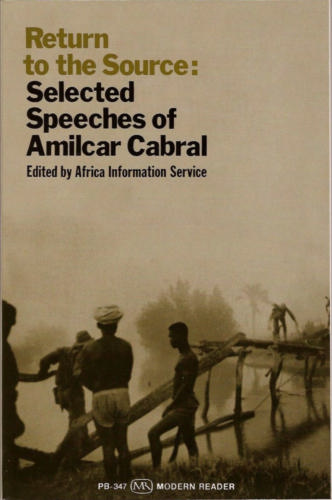
AIS subsequently published “
Return to the
Source: Selected Speeches by Amilcar Cabral”, the first major collection of
Cabral’s writings and speeches published in the United States, in 1973.
The AIS was also instrumental in coordinating Cabral’s final
visit the United States in 1972. During this visit Cabral asked the Africa
Information Service to set up a meeting with various leading forces in the BLM.
The
meeting was held in New York City on October 20 and involved participants from
over 30 BLM organizations. The speech was entitled “
Connecting the Struggles: An Informal talk with Black Americans”,
and had a profound and lasting impact on the BLM in all its diversity, as it
clearly affirmed the interconnectedness between the African liberation
struggles on the continent with those in the United States, the Caribbean, and
beyond.
Agents of the Portuguese colonialists assassinated Amilcar
Cabral shortly after his last trip to the United States on January 20, 1973
.
The effectiveness of Cabral’s work and leadership in helping to guide a peoples’
revolutionary movement proved the notion of “cut off the head and body will whither”
theory to be false in this case. Following his assassination, the PAIGC
escalated the war against the Portuguese and not only lead Guinea-Bissau to
political independence in 1974, but resulted in the overthrow of the Fascist Salazar-Cateano
regime in April 1974, that ruled Portugal since 1932, by a group of Portuguese
military officers called the Movimento das Armed Forcas or MAF (which
translated into English means Armed Forces Movement) admittedly influenced by
the theories and moral example of Amilcar Cabral
.
Half a world away, Cabral’s works had also become common
parlance within the BLM by the time of his death. His works greatly aided the
political and theoretical development of the BLM in the 1970’s, which
unfortunately played itself out in many fractious debates, broken alliances,
and organizational splits during the middle of the decade (many greatly aided
by the provocations of the Federal Bureau of Investigation or FBI). Despite the
fragmentation of the BLM during this period, Cabral’s work has had a lasting
influence on the movement, as it is still being studied and referenced today in
the formulation of strategy and the programmatic orientation of revolutionary
nationalist and Pan-Afrikanist organizations like the All African People’s
Revolutionary Party (AAPRP), the African People’s Socialist Party (APSP), the
Organization of Black Struggle (OBS), the Pan-African People’s Organization
(PAPO), the Provisional Government of the Republic of New Afrika (PG –RNA), the
Malcolm X Grassroots Movement (MXGM), and the New Afrikan People’s Organization
(NAPO).
In the 40 years since his untimely death, Amilcar Cabral’s
political legacy lives on in the strategies and tactics used by the forces of
the BLM to defeat the neo-colonial control of Black communities, the advance of
neo-liberal exploitation and social decomposition, to counter the consolidation
of the Black faction of the trans-national capitalist class, to stop the
genocidal assault against the working class via mass incarceration and economic
displacement, and build self-determining institutions and communities to
liberate our people.
What the radical forces in the BLM have learned to be
undeniably true is that as long as capitalism, colonialism, white supremacy,
patriarchy, imperialism, and neo-colonialism exist as forces that exploit and
oppress African (and all) people, Cabral’s insights and analysis will always
have relevance.
In our opinion, the foundation for national liberation
rests in the inalienable right of every people to have their own history,
whatever formulations may be adopted at the level of international law. The
objective of national liberation, is therefore, to reclaim the right, usurped
by imperialist domination, namely: the liberation of the process of development
of national productive forces. Therefore, national liberation takes place when,
and only when, national productive forces are completely free of all kinds of
foreign domination. The liberation of productive forces and consequently the
ability to determine the mode of production most appropriate to the evolution
of the liberated people, necessarily opens up new prospects for the cultural
development of the society in question, by returning to that society all its
capacity to create progress.
A people who free themselves from foreign domination
will be free culturally only if, without complexes and without underestimating
the importance of positive accretions from the oppressor and other cultures,
they return to the upward paths of their own culture, which is nourished by the
living reality of its environment, and which negates both harmful influences
and any kind of subjection to foreign culture. Thus, it may be seen that if
imperialist domination has the vital need to practice cultural oppression,
national liberation is necessarily an act of culture.
Amilcar Cabral, from “National Liberation and
Culture”, February, 20, 1970 Syracuse, New York.
References:
Books
Braganca, Aquino de, Wallerstein, Immanuel (1982) The African Liberation Reader, Three Volumes,
Zed Press, London, England.
Bush, Roderick D. (2009) The
End of White World Supremacy: Black Internationalism and the Problem of the
Color Line, Temple University Press, Philadelphia, Pennsylvania.
Bush, Roderick D. (2000) We
Are Not What We Seem: Black Nationalism and Class Struggle in the American
Century, New York University Press.
Cabral, Amilcar (1973) Return
to the Source: Selected Speeches by Amilcar Cabral, edited by Africa
Information Service, Monthly Review Press, New York, New York.
Cabral, Amilcar (1969) Revolution
in Guinea: An African People’s Struggle, Stage 1, London, England.
Cabral, Amilcar (1979) Unity
and Struggle: Speeches and Writings of Amilcar Cabral, Monthly Review
Press, New York, New York.
Chabal, Patrick (2003) Amilcar
Cabral: Revolutionary Leadership and People’s War, Africa World Press,
Trenton, New Jersey.
Cruse, Harold (2002) The
Essential Harld Cruse: A Reader, Palgrave Macmillian.
Davidson, Basil (1969) The
Liberation of Guinea: Aspects of an African Revolution, Penguin Books,
Middlesex, England.
Ferguson, Herman (2011) An
Unlikely Warrior: The Evolution of a Revolutionary, Black Classic Press.
Gaines, Kevin K. (2008) African
Americans in Ghana: Black Expatriates and the Civil Rights Era, University
of North Carolina Press.
Grady-Willis, Winston A. (2006) Challenging U.S Apartheid: Atlanta and Black Struggles for Human Rights
1960-1977, Duke University Press.
Johnson, Cedric (2007)
Revolutionaries to Race Leaders: Black Power and the Making of African American
Politics, University of Minnesota Press, Minneapolis, Minnesota.
Kadalie, Modibo M. (2000) Internationalism, Pan-Africanism, and the Struggle of Social Classes,
One Quest Press, Savannah, Georgia.
Lumumba, Chokwe (1991) The
Roots of the New Afrikan Independence Movement: Revolution Requires Maturity,
New Afrikan Productions, Jackson, Mississippi.
Meriwether, James (2009) Proudly
We can be Africans: Black Americans and Africa 1935-1961, University of
North Carolina Press.
McCulloch, Jock (1983) In
the Twilight of Revolution: The Political Theory of Amilcar Cabral,
Routledge and Kegan Paul, London, England.
Minter, William, Hovey, Gail, and Cobb, Charles Jr. (eds)
(2008) No Easy Victories: African
Liberation and American Activists over a Half Century 1950 – 2000, Africa
World Press, Trenton, New Jersey.
Sherwood, Marika (2011) Malcolm
X Visits Abroad, Tsehai Publishing, Los Angeles, CA.
Tyson, Timothy B. (2001) Radio
Free Dixie: Robert F. Williams and the Roots of Black Power, University of
North Carolina Press.
Van Deburg, William (1993) New Day in Babylon: The Black Power Movement and American Culture
1965-1975, University of Chicago Press.
Von Eschen, Penny (1997) Race
Against Empire: Black Americans and Anti-Colonialism 1937-1957, Cornell
University Press, New York, New York.
Young, Robert J. C. (2001) Postcolonialism: An Historical Introduction, Blackwell Publishing,
Oxford, England.
Articles
Davidson, Basil (1984) On Revolutionary Nationalism: The
Legacy of Cabral, Latin American
Perspectives, Issue 41, Volume II, pp. 15-42.
Magubane, Bernard (1983) Toward a Sociology of National
Liberation from Colonialism: Cabral’s Legacy, Contemporary Marxism: Journal of the Institute for the Study of Labor
and Economic Crisis, No. 7.
Mullen, Bill V. (2002) Transnational Correspondence: Robert
F. Williams, Detroit and the Bandung Era, Works
and Days, 39/40, Volume 20.
Unpublished Documents
Tyehimba, Watani Sundai Umoja (2012) ‘NAPO/MXGM Roots and
Timeline: A View from the House of Umoja’, Unpublished, Atlanta, Georgia.
There are three key speeches of Cabral that present the clearest articulations
of his theories and strategic reflections and which have had the most profound
and enduring impact on the BLM. These speeches are: “the Weapon of Theory”
(1966), “National Liberation and Culture” (1970), and “Identity and Dignity in
the Context of the National Liberation Struggle” (1972).
Cabral, Amilcar (1973)
Return to the
Source: Selected Speeches by Amilcar Cabral, pp 75-76.
Minter, William, Hovey, Gail, and Cobb, Charles Jr. (eds) (2008)
No Easy Victories: African Liberation and
American Activists over a Half Century 1950 – 2000, pp 15-22.
Young, Robert J. C. (2001)
Postcolonialism:
An Historical Introduction, pp. 204-216.
Mullen, Bill V. (2002)
Transnational
Correspondence: Robert F. Williams, Detroit and the Bandung Era.




 Posts
Posts